
Engineering & Design
FRP engineered to international codes — with the calculations to prove it.
Design that survives the service, not just the pressure test
Wall thickness is only part of the job. Our engineers evaluate resin selection, corrosion-barrier construction, surface veil, reinforcement architecture, thermal expansion, chemical compatibility and long-term aging — then produce stamped calculations so owners and inspectors can verify the design.
Engineering scope
- Structural design to ASME RTP-1 and BS EN 13121-3 (e.g. our cooling-tower calculation book)
- Resin/laminate selection for chemistry, temperature and abrasion
- Corrosion-barrier and veil specification
- Thermal expansion, support, anchor and nozzle-load analysis
- Fabrication drawings, GA drawings and as-builts
- Replacement/retrofit evaluations for aging FRP equipment
Complete design reports — engineered component by component
For a large tank, vessel, scrubber or duct, we don’t stop at a nominal wall thickness. Each major component is designed and checked on its own: the heads (flat, dished or F&D), the shell, nozzle-opening reinforcement, saddle design and stress analysis, lifting-lug and anchor-lug loads, and any internal media or support structure. The result is a complete design report an owner or inspector can follow from inputs to conclusions — the engineering that stands behind the fabrication.
Wind, seismic and snow loads — to recognized codes
Field equipment has to survive its environment, not only its process. We carry out wind, seismic and snow load analysis to widely recognized codes — including ASCE 7 for wind and the International Building Code (IBC) for seismic — using the real site parameters such as design wind speed, exposure category and risk/occupancy category. Internal and external design pressure, liquid head and specific gravity, and corrosion-barrier allowances are all carried through the same calculation set, so the equipment is verified against the loads it will actually see.
Finite element analysis for the difficult details
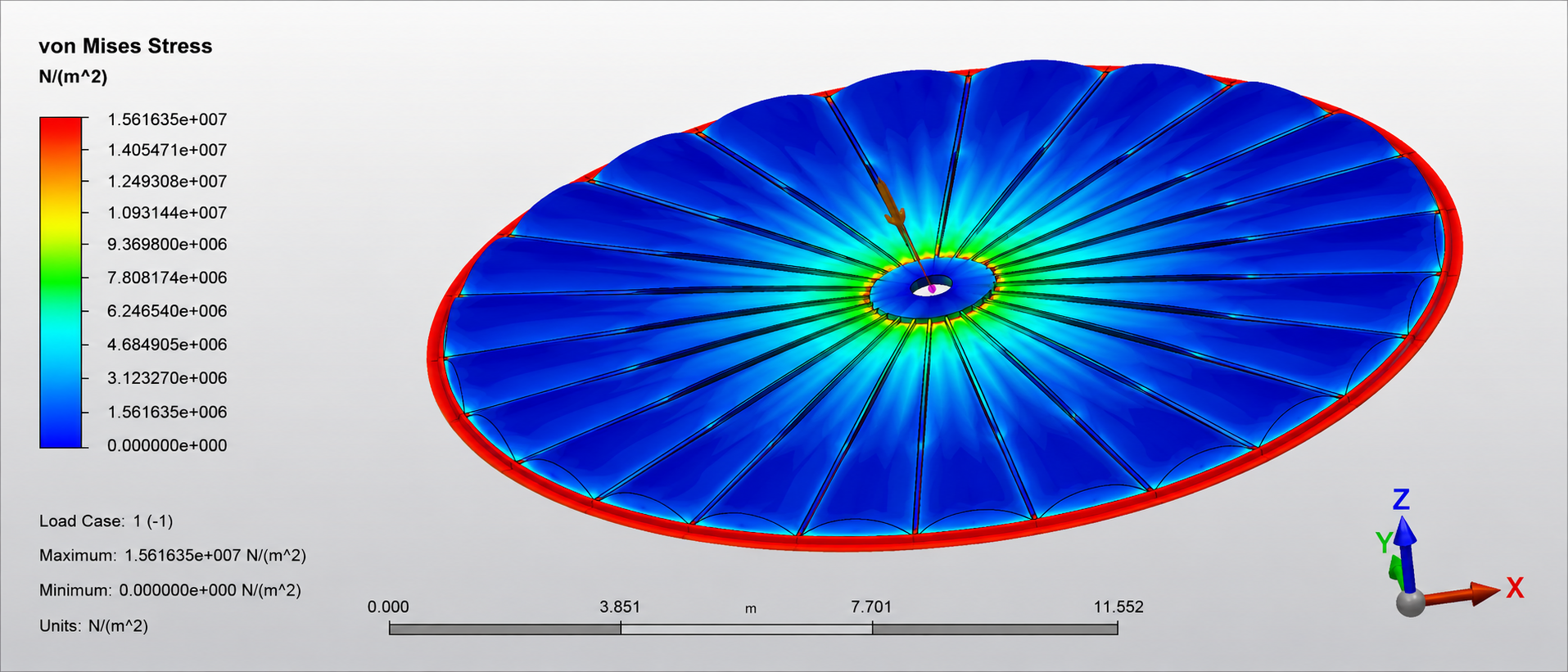
Where geometry or loading is too complex for closed-form hand calculations — saddle supports, large nozzles, lug attachments and other local details — our engineers use finite element analysis (FEA) to confirm stresses and deflections. Critical connections are validated before anything is laminated, reducing risk and rework in the shop and in the field.
PE-stamped calculations, certified for your jurisdiction
Many projects require design calculations stamped by a licensed Professional Engineer (PE) registered in the state or province where the equipment will operate. Crimar arranges independent PE review and stamping for the relevant jurisdiction, giving owners and authorities having jurisdiction a certified, defensible design basis — not just a fabricator’s word that the equipment is fit for service.
A collaborative, documented design review
Sound engineering is iterative. Our design work moves through structured review among Crimar’s engineering teams in the United States and Mexico together with independent composite-design specialists, with comments, revisions and decisions recorded at each step. That process settles the real questions before they reach the shop floor — for example, whether a support element should be built in FRP or stainless steel, or how to detail anchor attachments so that bonds and tapers develop their full strength.
What a Crimar engineering package can include
- A full design report — heads, shell, nozzle-opening reinforcement, saddle stress analysis, lifting and anchor lugs, and media/support structures
- Wind, seismic and snow load analysis, plus internal/external pressure and liquid loads, to ASCE 7 and IBC
- Finite element analysis (FEA) of critical connections and local details
- Professional Engineer (PE) stamp for the operating state or province
- Resin, laminate and corrosion-barrier specification matched to the chemistry, temperature and abrasion
- General-arrangement, fabrication and as-built drawings
- FRP-versus-metal component recommendations, with documented design review and revision history