
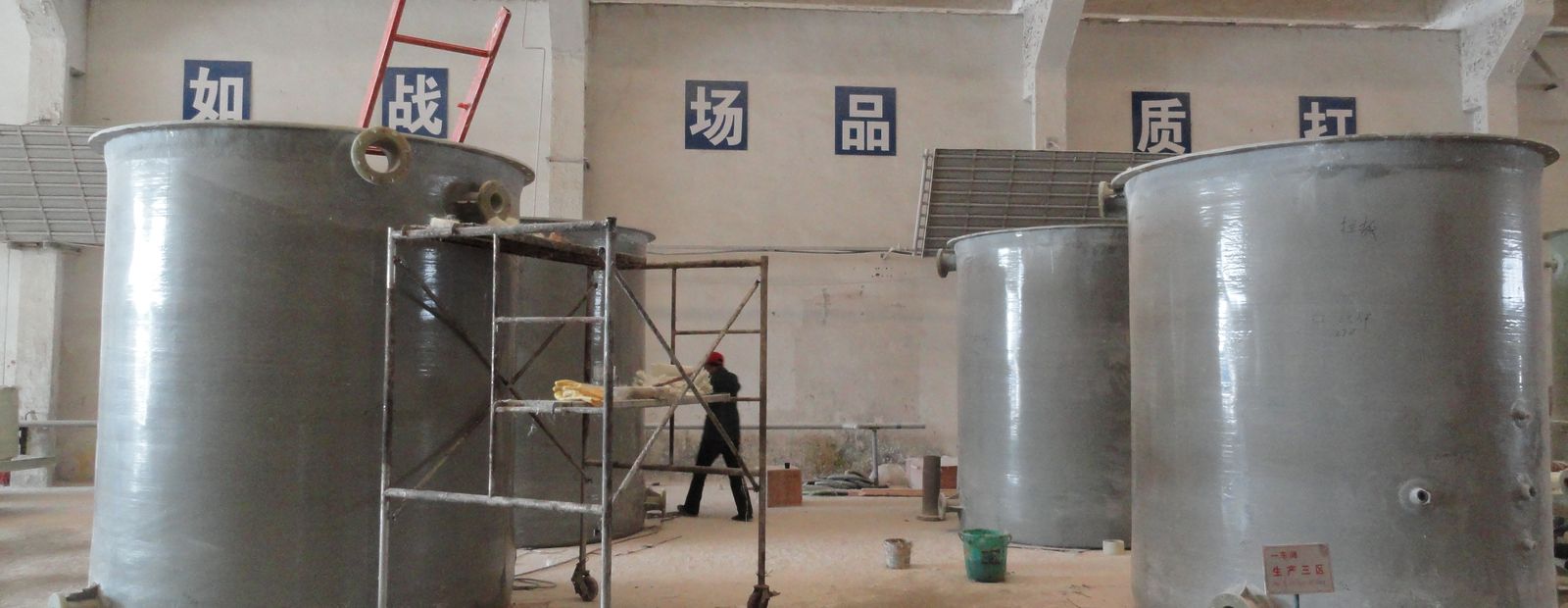
FRP for Chemical, Oil & Gas
Storage, reaction and scrubbing equipment for the most aggressive chemistry.
For chemical, petrochemical and process plants, Crimar builds FRP storage and reaction tanks, scrubbers, ductwork, piping, covers and linings matched to the chemistry, from hydrochloric and sulfuric acid to brine, oxidizers and solvents, and sources steel and alloy pressure equipment through our sister company in China.
The challenge
Acids, caustics, solvents, oxidizers and brines each need a specific corrosion barrier and resin. The wrong laminate fails fast; the right one lasts for decades. Getting the resin, barrier and veil right for the exact chemistry, concentration and temperature, including upset conditions, is the whole job.
Resin selection for chemical service
| Resin | Type | Typical use |
|---|---|---|
| Derakane 411 | Bisphenol-A epoxy vinyl ester | Broad resistance to acids, alkalis, bleaches and many organics; the general-purpose corrosion resin |
| Derakane 470HT | Novolac epoxy vinyl ester | Higher temperatures, strong acids, oxidizers and organic solvents |
| Derakane 510 series | Brominated, fire-retardant epoxy vinyl ester | Where a fire-retardant laminate is required (ASTM E84 flame spread 25 for 510B laminates) |
| Derakane 8084 | Elastomer-modified epoxy vinyl ester | Abrasion, impact and severe mechanical stress; primer for linings on steel and concrete |
| AROPOL 7334T | Isophthalic polyester | Less aggressive service; raw materials acceptable under FDA 21 CFR 177.2420 |
| Dual laminate | PP, PVC, PVDF or ECTFE liner with FRP structure | Chemistries beyond the range of a resin barrier |
FRP equipment for chemical plants
- Storage, mixing and reaction tanks and vessels, to ASME RTP-1 up to 15 psig, or ASTM D3299 / D4097 for atmospheric storage
- Scrubbers and absorption towers for HCl, acid mist and process fume
- Chemical-resistant piping and duct, including high-temperature and fire-retardant duct
- Covers for hot acid and chemical vapors
- FRP linings for existing steel and concrete tanks and floors
- Vacuum receivers and gas separators
Project record
- Chemical waste incineration plant, Nebraska: high-temperature duct system for 360 °F hydrochloric acid gas.
- Magnesium integration project, Qinghai, China (Hatch, 2014): 46 FRP HCl scrubbers, drying towers and condensers up to 4.7 m in diameter.
- Hydrochloric acid service for FLSmidth: ASME RTP-1 acid wash columns and dilute HCl tanks in Derakane 411.
- WesTech, Morocco: FRP full-vacuum hot acid receivers and associated tanks, and hot acid piping.
- Hot brine and hot acid vapor covers: a 45 m cover for a potash producer and 18.4 m covers for hot acid vapor in Madagascar.
- Pressure equipment: steel pressure vessels and coalescer filters for an industrial gas filtration OEM, sourced and documented through our sister company. See pressure vessels.
Standards
| Standard | Applies to |
|---|---|
| ASME RTP-1; ASTM D3299 / D4097 | Tanks and vessels; RTP-1 for pressure, vacuum and hazardous service |
| API RP 652 | Linings of tank bottoms |
| ASTM C582 | Contact-molded laminates for corrosion-resistant equipment, including the acetone test for surface cure |
How we work with chemical plants
Crimar mainly builds to the drawings and specifications of the end user and their engineering company, and adds the design input that is specific to FRP: resin and corrosion-barrier selection, laminate thickness, stiffening, nozzles, flanges, thermal expansion and supports. Every project runs on an inspection and test plan with hold and witness points and ends with a Manufacturing Data Record. We make FRP equipment in the USA, Mexico and China depending on the project, to Crimar’s specifications, and install it or supervise installation on site where needed.
For chemical service the resin decision comes first. We take the exact medium, concentration and temperature range, including cleaning and upset conditions, check them against the resin manufacturer’s chemical-resistance data, and get the manufacturer’s written recommendation for demanding services. The laminate, veil and any thermoplastic liner follow from that, and the vessel is then designed to ASME RTP-1 or ASTM D3299 / D4097 as the specification requires.
What we need to quote
- Medium, concentration, specific gravity and any mixtures or reactions
- Operating and design temperature and pressure, including vacuum, cleaning and upset conditions
- Dimensions or capacity, nozzles, internals and agitation
- Fire-retardant, static and inspection requirements
- Site seismic, wind and snow loads and delivery scope
FRP for chemical processing: frequently asked questions
Which resin should I use for hydrochloric acid?
Bisphenol-A epoxy vinyl ester (Derakane 411) is the usual choice for dilute hydrochloric acid at moderate temperature, as in our acid wash columns and dilute HCl tanks. For concentrated acid or higher temperature, the resin and barrier are chosen from the manufacturer’s chemical resistance data for the exact concentration and temperature.
Can FRP handle solvents and oxidizers?
Many of them, with novolac vinyl ester such as Derakane 470HT, which is designed for strong acids, oxidizers and organic solvents over a wide temperature range. Where the chemistry is beyond any resin barrier, a dual laminate with a PVDF, ECTFE, PP or PVC liner is used.
Can you line an existing steel tank?
Yes. The steel is blasted to white metal, primed with Derakane 8084, then laminated with glass mat to about 0.25 in., a surfacing veil and a final resin-and-wax coat. Tank bottom linings follow API RP 652 where specified.
What pressure can an FRP chemical vessel take?
Up to 15 psig internal or external under ASME RTP-1 with a proof test of the as-built laminate, and 2 psig without one. Atmospheric storage tanks are usually built to ASTM D3299 or D4097.
Do you also supply steel or alloy equipment?
Yes. Through our sister company in China we source steel and stainless pressure vessels, heat exchangers, pipe and valves, inspected and documented like our FRP.
Do you get the resin manufacturer’s recommendation?
For demanding services, yes: the resin, veil, corrosion barrier thickness and post-cure are confirmed with the resin manufacturer’s written recommendation for the specific medium and temperature.
Can FRP be used in hazardous or classified areas?
Yes, with a conductive corrosion barrier using a carbon veil or conductive fillers and grounding connections where static dissipation is required, and fire-retardant resins where the specification calls for a flame-spread rating.