
FRP Scrubbers & Towers
Crimar builds FRP wet scrubbers, absorption and humidifying towers for emission control and gas treatment. Packed-bed and venturi designs are engineered with integral sumps, spray systems and mist eliminators, and fabricated in FRP for long life in acidic and oxidizing service.
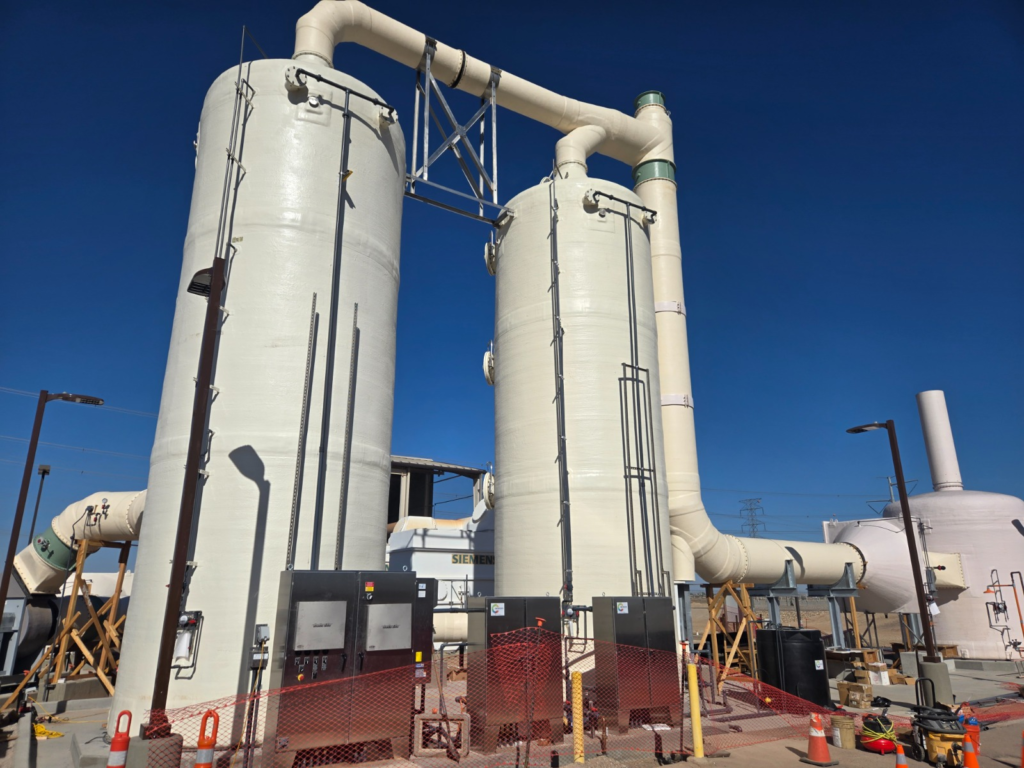
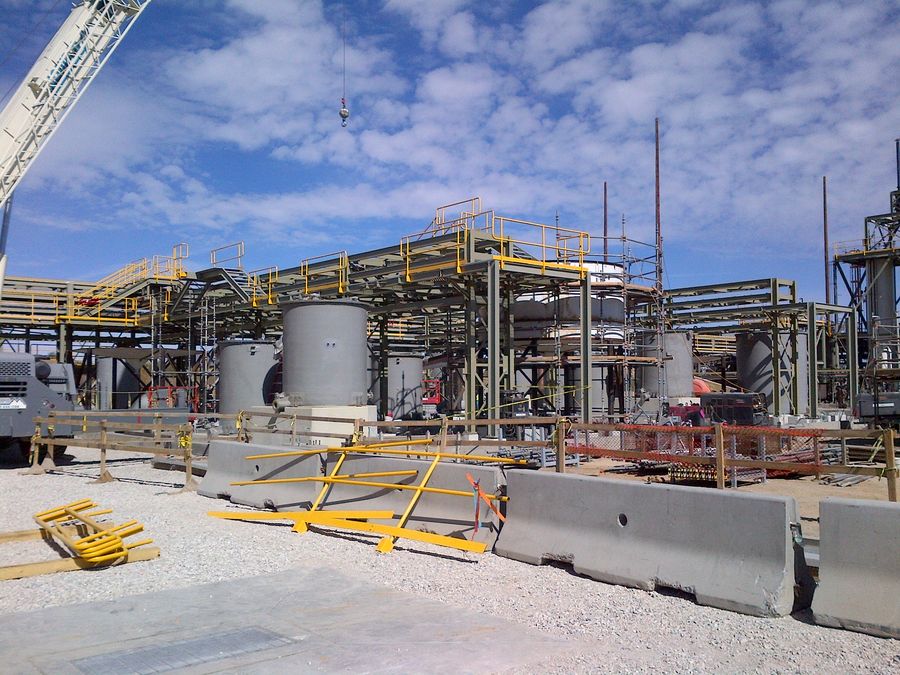
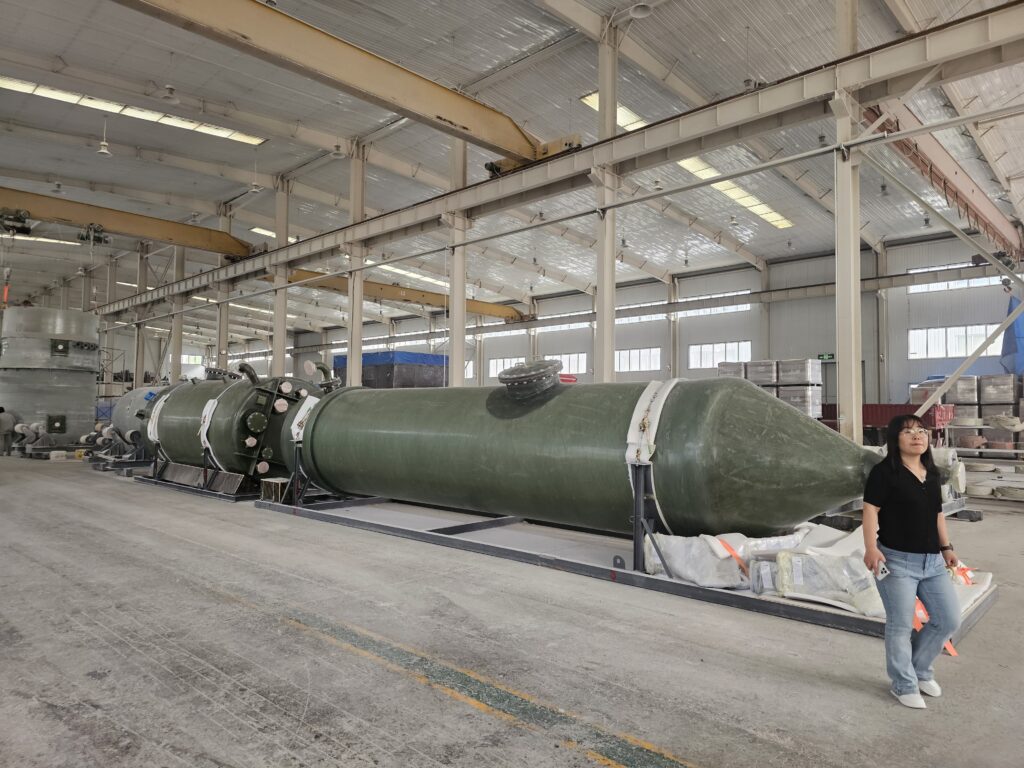
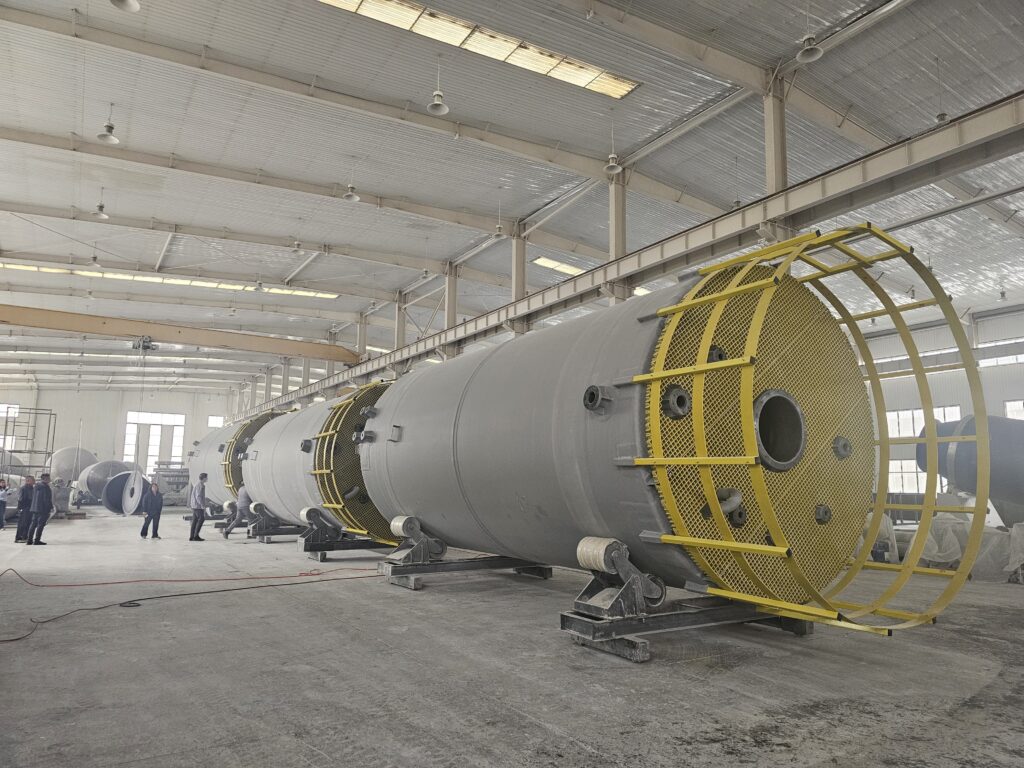
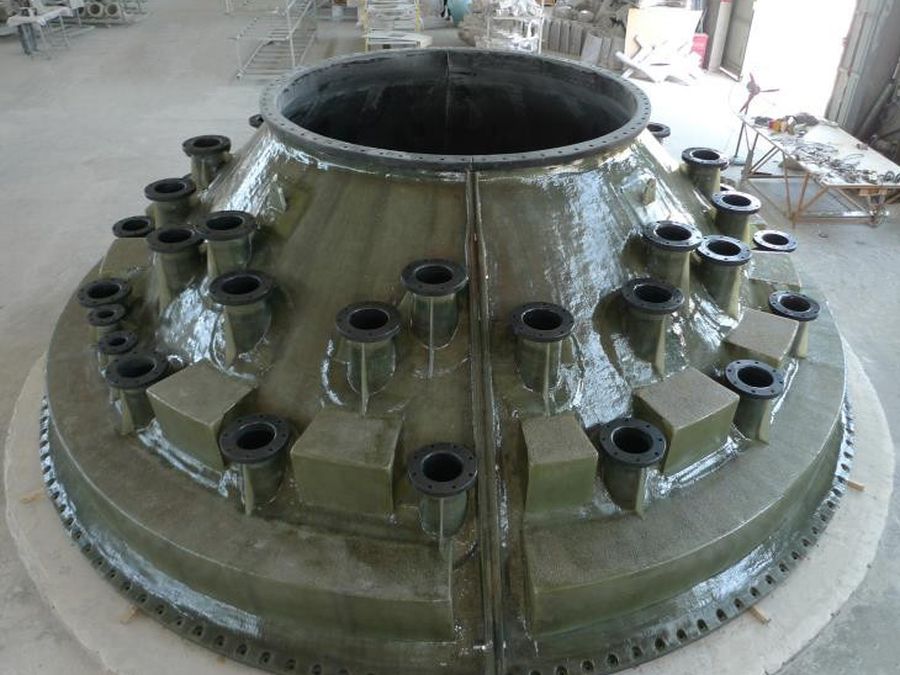
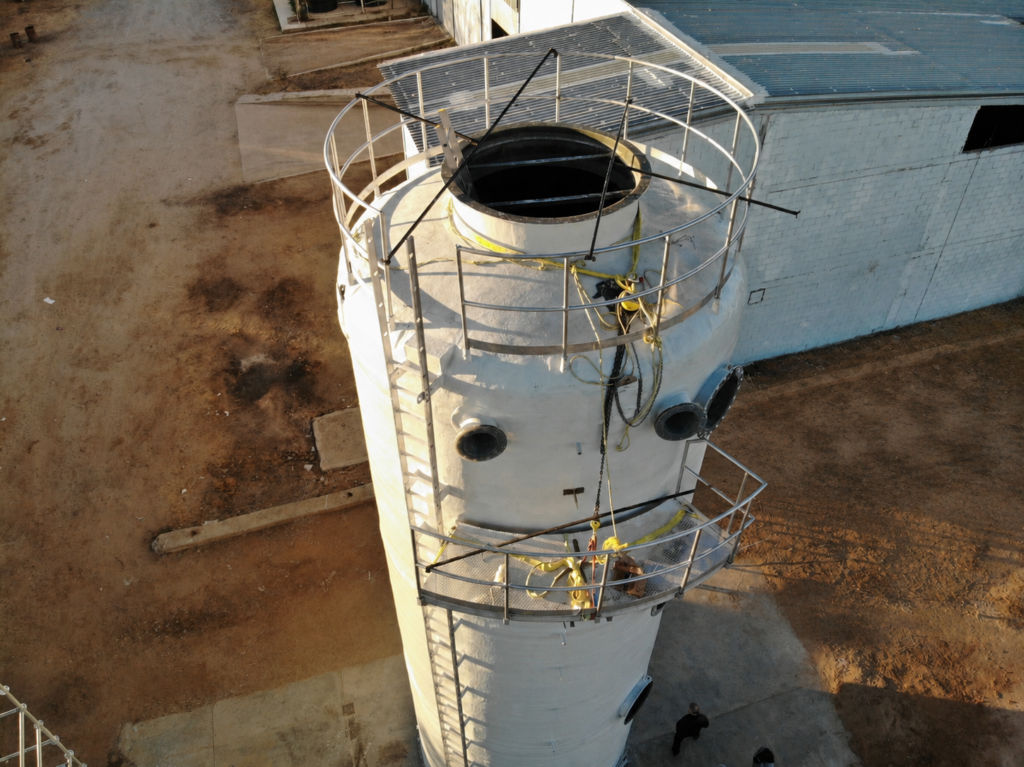
FRP scrubber and tower specifications
Scrubbers are process equipment: the gas flow, inlet chemistry and emission limit set the size, packing and recirculation rate, usually from the process designer’s datasheet. We build the FRP shell, sump, internals supports and connections to that design and add the FRP-specific engineering: resin and liner selection, laminate thickness, nozzle reinforcement, thermal protection and supports.
| Parameter | Range and options |
|---|---|
| Equipment | Packed-bed and venturi wet scrubbers, quench sections, absorption towers, humidifying towers, condensers, demister and mist-eliminator housings, stacks. |
| Service | SO₂/SO₃ and acid mist, hydrogen chloride, odor and hydrogen sulfide, particulate and process fume. |
| Size | Shop-built towers shipped whole; larger shells are wound or assembled on site up to 15 m in diameter. |
| Internals | Integral sumps, packing supports, spray headers, liquid distributors and multi-stage mist eliminators, designed separately from the shell as ASME RTP-1 requires. |
| Construction | Filament-wound shells; contact-molded heads, cones, transitions and nozzles; dual-laminate with thermoplastic liners for the most aggressive chemistry. |
| Thermal protection | PTFE nozzle sleeves and a graphite veil with graphite-filled resin in the corrosion barrier where hot gas enters, to spread heat and prevent thermal-shock blistering. |
| Standards | ASME RTP-1 for the vessel shell; ASTM D3299 / D4097; ANSI B16.47 large-diameter flanges where specified. |
| Package scope | Scrubbers with the interconnecting duct, dampers, recirculation tanks and piping as one coordinated FRP package. |
| Quality | ITP and Manufacturing Data Record; Barcol, thickness, dimensional and visual inspection; third-party witness on request. |
Delivered scrubbers and towers: one project in detail
For a magnesium integration project in Qinghai, China, engineered by Hatch and completed in 2014, we supplied 46 FRP scrubbers, towers and condensers for evaporator vapor, granulation and hydrogen chloride drying service:
| Equipment | Size (diameter × height) | Quantity |
|---|---|---|
| Evaporator vapor scrubber | 2,800 × 6,000 mm | 2 |
| Granulation tower scrubber | 4,000 × 12,950 mm | 6 |
| Air dryer spray scrubber | 4,700 × 8,100 mm | 6 |
| Air dryer HCl scrubber | 4,700 × 5,700 mm | 6 |
| Air dryer rear scrubber | 4,700 × 7,550 mm | 6 |
| Cleaning tower | 1,700 × 7,000 mm | 2 |
| Hydrogen chloride dryer spray scrubber | 3,600 × 6,750 mm | 6 |
| Hydrogen chloride dryer condensers No. 1 and No. 2 | 3,400 × 6,020 mm | 6 + 6 |
Other scrubber work includes an acid scrubber with two-stage caustic scrubbers, interconnecting duct, dampers and chemical tanks built to ASTM D3299 / D4097 with ANSI B16.47 flanges (see the scrubber and ductwork package); duct, stacks, quench sections and venturi scrubbers for a potash producer in New Mexico; a humidifying tower cover, demister housing and acid pump tank for Glencore’s PASAR copper smelter; and mist eliminators for Biorem odor-control systems.
Designing an FRP scrubber for its gas
Resin and corrosion barrier
The corrosion barrier faces saturated, acidic gas and recirculating liquor at the same time, so it is chosen for the worse of the two. Bisphenol-A epoxy vinyl ester handles most SO₂, acid mist and odor-control duty; novolac vinyl ester is used for hotter gas, solvents and strong oxidizers; and thermoplastic liners are added where the chemistry is beyond a resin barrier. The barrier is at least 2.5 mm thick, per ASME RTP-1.
Hot inlets and quench sections
The inlet of a quench or scrubber is where FRP is most likely to fail, because hot gas meets cold liquid. We protect these zones the same way we do in smelter duct and quench vessels: a graphite veil and graphite-filled resin in the barrier spread the heat into the structural wall, and PTFE sleeves protect nozzles. The design data must include the normal, maximum and upset gas temperatures and how long an excursion can last.
Internals and loads
Packing supports, spray headers and mist eliminators are outside the scope of ASME RTP-1 and are designed as separate items, then attached to supports designed into the shell. Wind, seismic and nozzle loads, the weight of wet packing and the liquid in the sump all go into the shell calculation.
Resins and datasheets
Materials & resins
We select the corrosion barrier and structural laminate for each service — Derakane™ epoxy vinyl ester and AROPOL™ isophthalic polyester systems — matched to the chemistry, temperature and abrasion of your process. Common choices and datasheets:
Derakane 411 — general corrosion · Derakane 470HT — high temperature · Derakane 510B — fire retardant (ASTM E84 flame spread 25) · Derakane 8084 — abrasion / elastomer-modified · AROPOL 7334T — isophthalic
FRP scrubbers and towers: frequently asked questions
Why build a scrubber in FRP instead of steel?
Because the inside of a wet scrubber is permanently wet with acidic or chloride-bearing liquid, which corrodes carbon steel and pits stainless steel. An FRP shell has its corrosion barrier built into the wall, chosen for the specific gas and liquor, and it is light enough to ship and erect large towers in one piece.
How large can an FRP scrubber be?
Towers that fit on a truck are shop-built and shipped whole; on one project we supplied towers up to 4.7 m in diameter and up to about 13 m tall. Larger shells are wound or assembled on site, up to 15 m in diameter.
Does ASME RTP-1 cover scrubbers?
It covers the vessel shell, but not internals such as packing supports, liquid distributors and mist eliminators, or ducts and stacks. We design the shell to RTP-1 or ASTM D3299 / D4097, as your specification requires, and design internals and their supports as separate items.
What happens if the gas temperature spikes?
A temperature excursion above the resin’s limit is the most common cause of scrubber damage, usually as blistering of the corrosion barrier at the inlet. Tell us the upset temperature and its duration; we then select the resin, add graphite thermal protection at the inlet and, where needed, a quench section ahead of the scrubber.
Can you supply the whole scrubbing system?
Yes. We regularly supply scrubbers with the interconnecting duct, dampers, stacks, recirculation tanks and piping as one FRP package, with matched flanges and one resin system and one inspection plan across the package.
What do you need to quote a scrubber?
The process datasheet: gas flow, composition and temperature (normal, maximum and upset), pressure drop, scrubbing liquor and its chemistry, packing type and depth, and emission target. Then the general arrangement with nozzles, internals, ladders and platforms, and the site wind and seismic loads.
Request a quote for FRP Scrubbers & Towers
Send your drawings or service conditions and our engineers will spec it with you.