
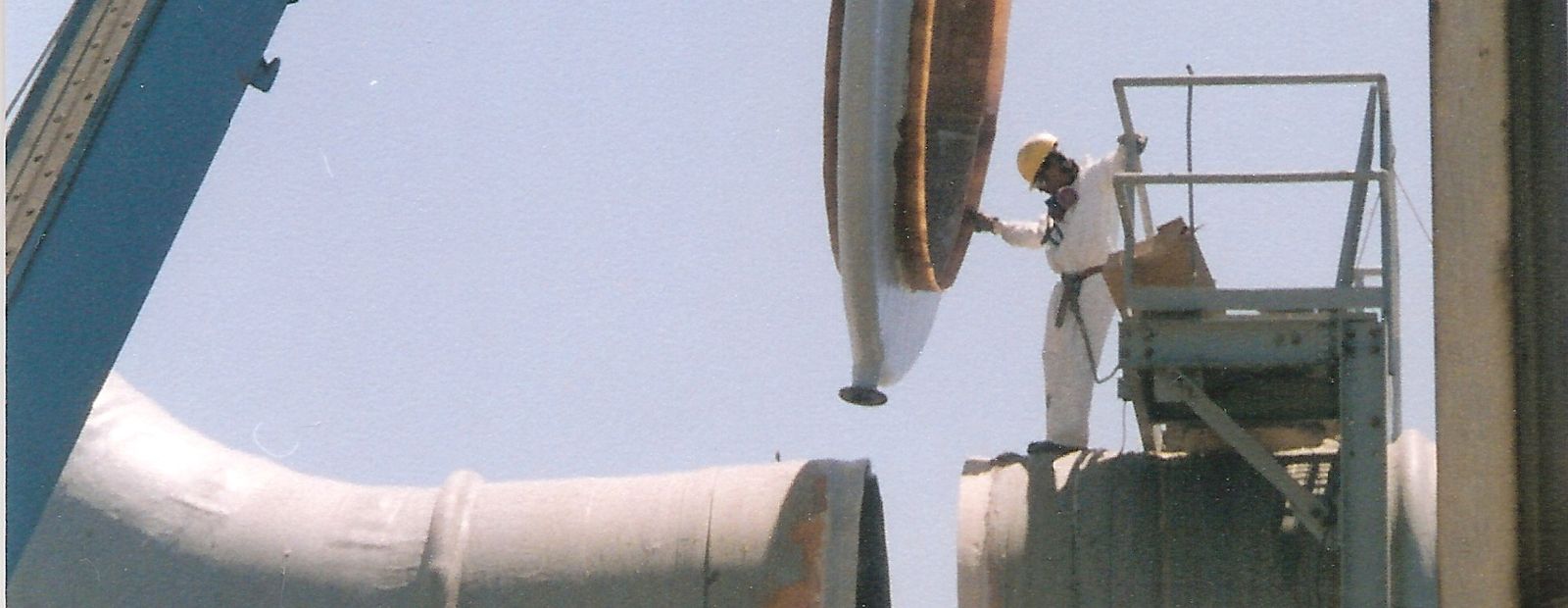
FRP for Power & Flue-Gas
FGD scrubbers, flue-gas ductwork, dampers and expansion joints built for hot, acidic gas.
For flue-gas cleaning and air-pollution control in power, metallurgical and process plants, Crimar supplies FRP scrubbers, flue-gas duct, stacks, dampers and expansion joints engineered for hot, wet, acidic gas and constant movement.
The challenge
Flue-gas and wet scrubbing systems combine acidic condensate, heat and continuous thermal and mechanical movement. Duct grows and moves, dampers must seal against dirty gas, and the wet zone downstream of a scrubber corrodes carbon steel and pits stainless. Temperature excursions are the most common cause of damage to FRP, so the design has to start from the upset conditions, not just the normal ones.
FRP equipment for flue-gas service
| Equipment | What we supply | Key design points |
|---|---|---|
| Wet scrubbers and quenches | Packed-bed and venturi scrubbers, quench sections, absorption towers | Resin for the worse of gas and liquor; graphite thermal protection at the hot inlet |
| Flue-gas duct and stacks | Round and rectangular FRP duct, transitions, stacks | Wall from SMACNA and calculation; vacuum from fan shut-off; supports for thermal growth |
| Dampers | FRP dampers; FRP-lined steel butterfly dampers DN1300–DN1800 | ≤1 % leakage with PFA seal; delivered for 80 °C and −3.4 kPa |
| Expansion joints | Crimar FRP expansion joints | Same resin and barrier as the duct; in service at copper smelters for 30+ years |
| Reagent and process tanks | Reagent and recirculation tanks | To ASTM D3299 / D4097 or ASME RTP-1 |
Resins for hot gas
| Resin family | Typical resin HDT (ASTM D648) |
|---|---|
| Epoxy vinyl ester (bisphenol-A) | 105 °C / 220 °F |
| Novolac epoxy vinyl ester | 150 °C / 300 °F |
| High-temperature novolac epoxy vinyl ester | 180 °C / 360 °F |
| Brominated fire-retardant epoxy vinyl ester | 106–121 °C / 223–250 °F |
Where a fire-retardant laminate is required, brominated vinyl ester resins reach an ASTM E84 Class I flame spread of 25 or less per the resin manufacturers’ data, with or without antimony trioxide depending on the grade; the rating is confirmed by testing of the specified laminate.
Project record
- FRP-lined butterfly dampers, DN1300–DN1800: for sulfur-bearing gas under vacuum in a metallurgical gas-handling system, each unit seal-tested. Case study.
- Scrubber and ductwork package: an acid scrubber, two-stage caustic scrubbers, interconnecting duct, dampers and chemical tanks to ASTM D3299 / D4097. Case study.
- Copper smelter gas systems in Texas, New Mexico and Arizona: duct up to 120 in. with FRP dampers and expansion joints.
- Chemical waste incineration plant, Nebraska: 360 °F HCl gas duct.
- Potash producer, New Mexico: stack, duct, quench sections and venturi scrubbers.
- Steel producer: FRP dampers.
How we work on flue-gas projects
Crimar mainly builds to the drawings and specifications of the end user and their engineering company, and adds the design input that is specific to FRP: resin and corrosion-barrier selection, laminate thickness, stiffening, nozzles, flanges, thermal expansion and supports. Every project runs on an inspection and test plan with hold and witness points and ends with a Manufacturing Data Record. We make FRP equipment in the USA, Mexico and China depending on the project, to Crimar’s specifications, and install it or supervise installation on site where needed.
Flue-gas systems are designed by the process or APC engineer; we build the FRP equipment to that design and check the FRP-specific points: the resin against the maximum and upset gas temperatures, the corrosion barrier against the condensate chemistry, the wall against vacuum and fan shut-off, and the supports and expansion joints against thermal growth. Scrubbers, duct, dampers and tanks can be supplied as one package with matched flanges and one inspection plan.
What we need to quote
- Gas composition and condensate chemistry
- Normal, maximum and upset gas temperatures, and how long an excursion lasts
- Design pressure and vacuum, including fan shut-off
- Equipment list or layout: scrubbers, duct sizes and lengths, dampers, expansion joints, stacks
- Fire-retardant and conductivity requirements, site loads and installation scope
FRP for power and flue gas: frequently asked questions
Is FRP suitable for flue-gas desulfurization and wet scrubbing?
Yes, for the wet, acidic part of the system: scrubbers, quenches, outlet duct and stacks, where acidic condensate corrodes steel. The resin is selected for the gas and liquor at the maximum and upset temperatures.
What is the temperature limit of FRP flue-gas duct?
It is set by the resin. Bisphenol-A vinyl ester resins have a cast HDT of about 220 °F, novolac grades about 300 °F and high-temperature novolac grades about 360 °F; we have supplied duct for 360 °F HCl gas. The service limit is confirmed by the resin manufacturer for each project.
How do you handle thermal expansion?
With FRP expansion joints laminated into the duct and a support system designed to let it move without overstressing flanges and branches. Crimar’s FRP expansion joint design has been used at copper smelters for more than 30 years.
Can FRP-lined dampers isolate flue gas reliably?
Yes. Our DN1300–DN1800 FRP-lined butterfly dampers hold ≤1 % leakage with a PFA sealing face and graphite shaft packing, at up to about 80 °C and −3.4 kPa, and are seal-tested before shipment.
Can the duct be fire retardant?
Yes, with brominated vinyl ester resins that achieve an ASTM E84 Class I flame spread of 25 or less per the resin manufacturers’ data, confirmed by testing where the specification requires a rating.
Can you supply a complete scrubbing system?
Yes. We supply scrubbers with the interconnecting duct, dampers, stacks and recirculation tanks as one FRP package with matched flanges, one resin system and one inspection plan.
What causes FRP damage in flue-gas service?
Most often a temperature excursion above the resin’s limit, which blisters the corrosion barrier at the hot inlet. We design against it with resin selection for the upset temperature, graphite thermal protection at hot spots and, where needed, a quench ahead of the FRP.