
FRP Ductwork & Piping
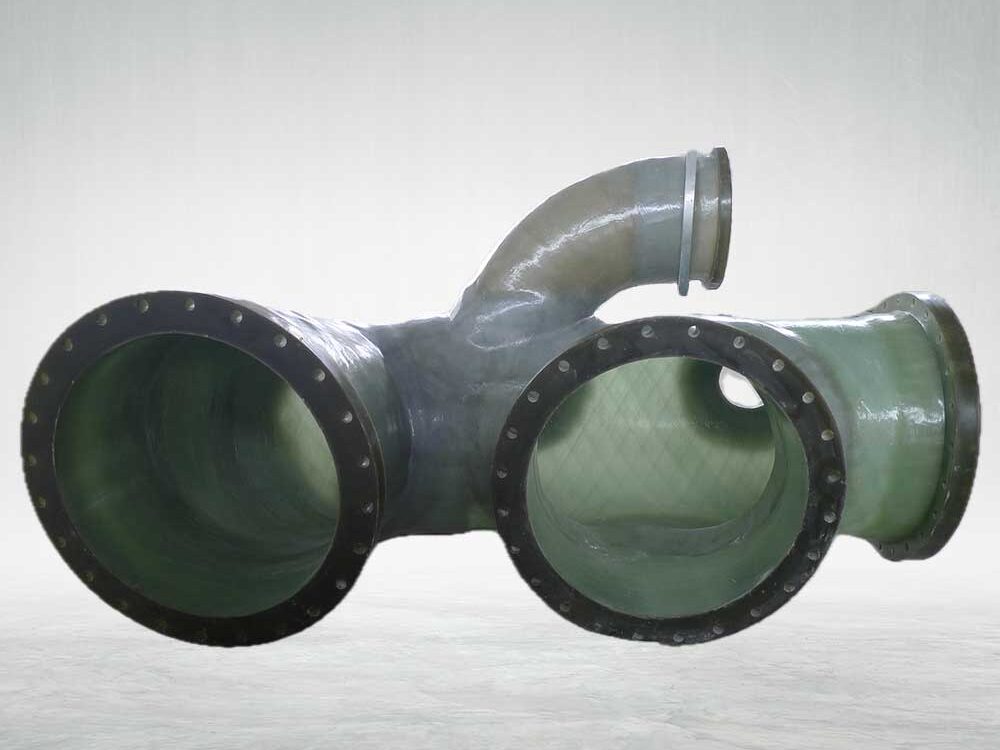
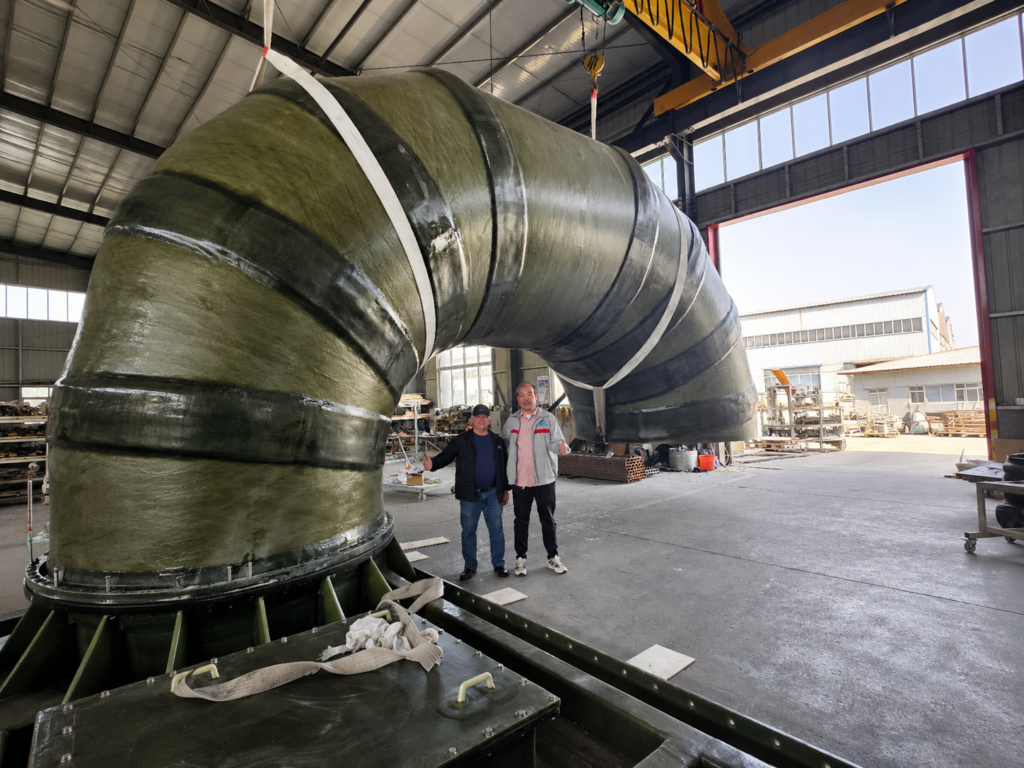
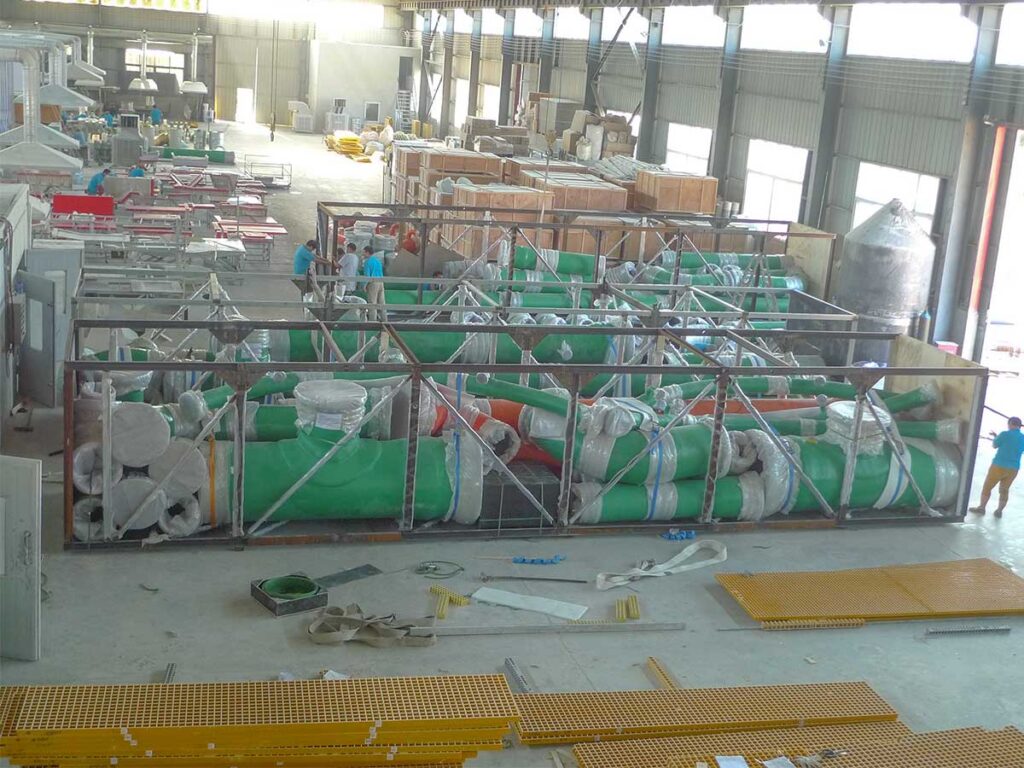
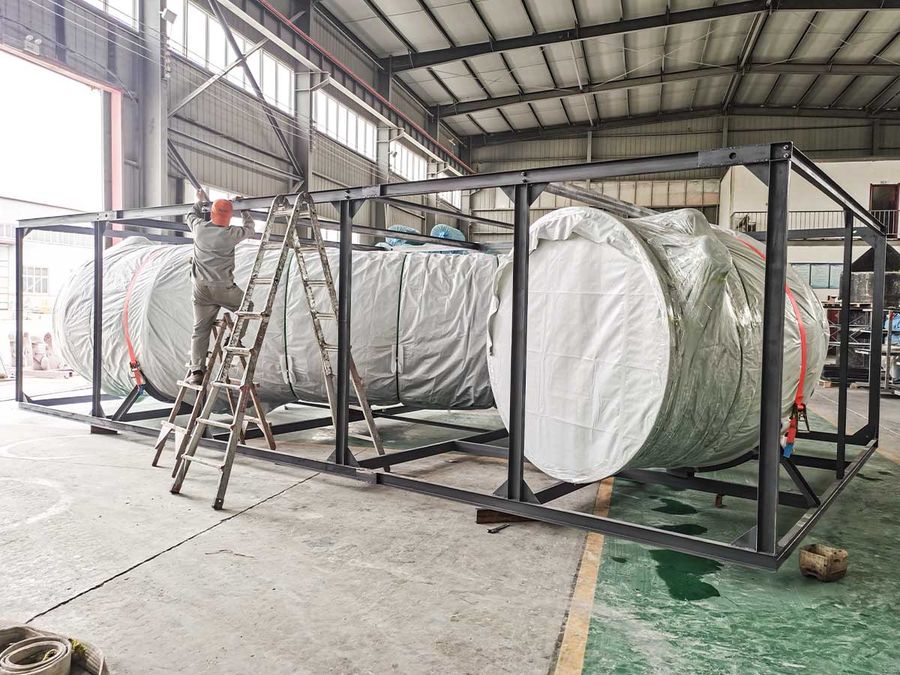
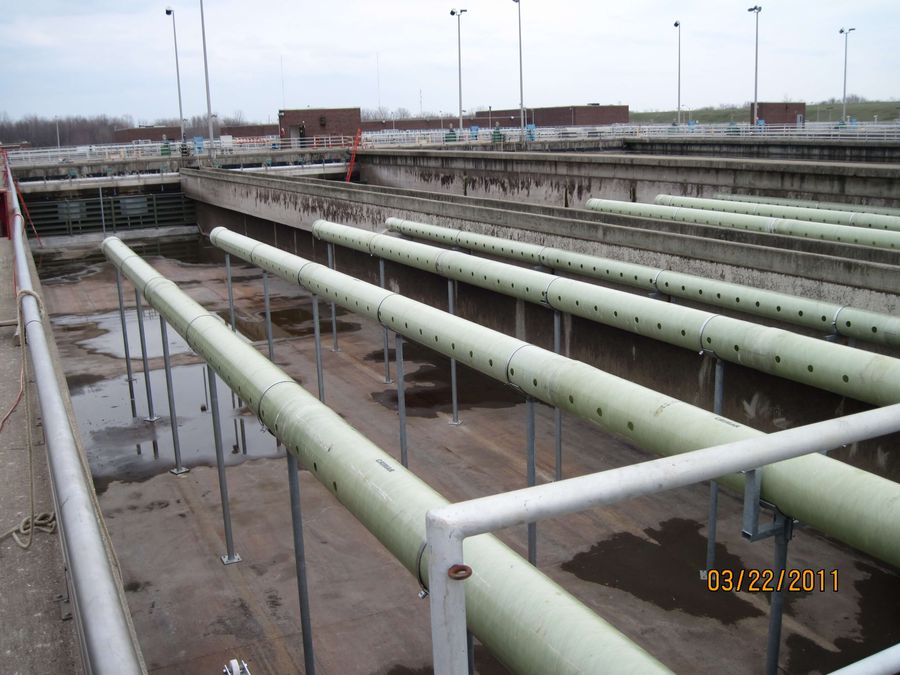
FRP duct and pipe carry corrosive fume, off-gas and process fluids where steel corrodes and coatings fail. Crimar contact-molds and filament-winds duct, pipe and a full range of fittings — engineered, shop-fabricated and delivered as ready-to-install spools with matched flanges and supports.
FRP duct and pipe specifications
These are the ranges and options we design and build to. Each duct or pipe system is engineered for its own gas or liquid, temperature, pressure and supports, so the figures for your project come from its design calculation.
| Parameter | Range and options |
|---|---|
| Duct diameters delivered | 48, 72, 84, 96, 102 and 120 in. ID (1,219–3,048 mm) for copper smelter off-gas systems; other diameters and metric DN sizes designed to order. |
| Shapes | Round duct and pipe; rectangular duct contact-molded to the internal width × height you specify, with external stiffeners. |
| Construction | Filament winding for straight round runs, including large diameters; contact molding (hand lay-up) for rectangular duct, elbows, tees, transitions, hoods and custom fittings. |
| Pressure and vacuum | Positive and negative pressure; SMACNA tables cover round duct 4–72 in. to ±30 in. wg (7,500 Pa). Larger diameters, higher pressures and other spans are calculated for each project. |
| Temperature | Set by the resin and the chemistry. We have supplied duct for 360 °F (182 °C) HCl gas service using high-temperature novolac vinyl ester. |
| Corrosion barrier | Veil plus chopped-strand mat in the selected resin, typically a minimum of 2.5 mm (100 mil). |
| Liner options | Abrasion-resistant FRP liner for entrained solids; PVC or polypropylene thermoplastic liner (dual laminate); carbon veil or conductive fillers for static dissipation. |
| Fire retardant | Brominated vinyl ester laminates rated ASTM E84 Class I (flame spread 25 or less) per the resin manufacturers’ data, confirmed by testing where specified. |
| Fittings | Elbows at any angle, reducers, round-to-rectangular transitions, tees and branches, stacks, expansion joints, dampers, inspection doors, drains and instrument ports. |
| Joints | Integral flanges with bolt circle and drilling to your standard (for example ASME B16.5); butt-and-strap field joints per SMACNA. |
| Supports | Spacing, saddles and hangers designed with the duct; support steel can be included. |
| Quality | ISO 9001; project Inspection and Test Plan (ITP) and Manufacturer’s Data Report (MDR). |
Minimum wall thickness for round FRP duct
For round duct up to 72 in. we start from the SMACNA Thermoset FRP Duct Construction Manual. The table applies to positive pressure up to +30 in. wg (7,500 Pa), temperatures up to 180 °F (82 °C) with resin HDT of at least 180 °F, supports at no more than 10 ft (3,050 mm) and a safety factor of at least 4.0. Larger diameters, higher temperatures and other spans are calculated for each project.
| Duct diameter | Filament wound (Type X) | Contact molded (Types I/II) |
|---|---|---|
| 4–12 in. (100–300 mm) | 0.140 in. (3.56 mm) | 0.125 in. (3.18 mm) |
| 13–36 in. (325–900 mm) | 0.180 in. (4.57 mm) | 0.188 in. (4.76 mm) |
| 37–42 in. (950–1,050 mm) | 0.180 in. (4.57 mm) | 0.250 in. (6.35 mm) |
| 43–72 in. (1,075–1,800 mm) | 0.220 in. (5.59 mm) | 0.250 in. (6.35 mm) |
Vacuum usually governs the wall of larger duct. A 48 in. filament-wound duct with a 0.220 in. wall, for example, is rated for 15 in. wg of vacuum in the same SMACNA tables, and 30 in. wg needs 0.300 in. Fan shut-off and upset conditions should be included in the design pressure, because they set the vacuum the duct must hold.
Resin families and temperature
The resin sets both the chemical resistance and the temperature limit of the duct or pipe. Heat distortion temperature (HDT) is a property of the cast resin, not a service rating; the maximum service temperature depends on the chemistry and is confirmed by the resin manufacturer for each project.
| Resin family | Typical service | Typical resin HDT (ASTM D648) |
|---|---|---|
| Epoxy vinyl ester (bisphenol-A) | General acid and caustic service: smelter off-gas, scrubber duct, odor control, wet SO₂ and weak sulfuric acid | 105 °C / 220 °F |
| Novolac epoxy vinyl ester | Higher temperatures, solvents and hot acid gases | 150 °C / 300 °F |
| High-temperature novolac epoxy vinyl ester | Hot gas streams beyond the range of standard novolac grades | 180 °C / 360 °F |
| Brominated fire-retardant epoxy vinyl ester | Duct where the specification calls for reduced flame spread | 106–121 °C / 223–250 °F |
| Elastomer-modified epoxy vinyl ester | Improved impact and thermal-cycling resistance | 82 °C / 180 °F |
For one copper smelter off-gas service (13–15 % SO₂, 10 % dilute sulfuric acid, entrained solids and trace fluorides, −40 to 80 °C), the resin manufacturer’s written recommendation was epoxy vinyl ester throughout, a synthetic surfacing veil backed by boron-free ECR-glass chopped-strand mat, a corrosion barrier of at least 2.5 mm, a post-cure at 80 °C for 4 hours, and an abrasion-resistant liner where solids impinge. That is an example from one project, not a standard specification: resin, veil, liner and post-cure are selected for each service.
FRP pipe: laminate construction and properties
FRP pipe uses the same layered wall as our tanks and duct. The inner surface is a resin-rich layer reinforced with a C-glass or synthetic (Nexus) veil, 10–20 mils (0.25–0.51 mm) thick at about 90 % resin by weight. Behind it, two plies of 1.5 oz/ft² (450 g/m²) chopped strand make an interior layer of 85–95 mils (2.2–2.4 mm) at 22–32 % glass; aggressive or abrasive service can call for more. The structural layer carries pressure, wind and seismic loads: alternating chopped strand and 24 oz/yd² (800 g/m²) woven roving at 30–45 % glass in contact-molded pipe, or helically wound continuous roving at 55–70 % glass in filament-wound pipe. An outer resin coat with UV absorbers protects outdoor runs.
| Nominal property | Contact molded | Filament wound |
|---|---|---|
| Specific gravity | 1.5–1.8 | 1.8–2.1 |
| Tensile strength | 9,000–25,000 psi (62–172 MPa) | 25,000–50,000 psi hoop (172–344 MPa) |
| Flexural strength | 16,000–22,000 psi | 20,000–40,000 psi hoop |
| Tensile modulus | 0.8–1.1 × 10⁶ psi | 2.0–3.5 × 10⁶ psi hoop; 0.9–1.4 × 10⁶ psi axial |
| Thermal conductivity | 1.3–1.8 Btu·in/hr·ft²·°F | 1.3–1.8 Btu·in/hr·ft²·°F |
| Barcol hardness | 27–45 | 27–45 |
FRP pipe weighs about one-sixth as much as steel pipe of the same size, which simplifies supports and installation. Flanges and fittings are built to ASME B16.5 drilling, ASTM D5421 for contact-molded flanges and ASME B31.3 where the piping specification calls for it, with surface cure checked by the acetone test of ASTM C582.
Quality and documentation
Every duct and pipe project runs on an Inspection and Test Plan that lists each step with its acceptance criteria and marks the hold and witness points for you or your inspector. Incoming resin and glass are batch-traced with certificates, and gel time is tested on a sample from each resin drum. During fabrication we record shop temperature and dew point and the laminate sequence. Finished parts get Barcol hardness against ASME RTP-1 criteria, an acetone test of surface cure, a visual inspection of the corrosion barrier to RTP-1 acceptance criteria, a spark test for pinholes, a vacuum test and a dimensional check. The Manufacturer’s Data Report with drawings, ITP sign-offs, certificates and records ships with the equipment. See our quality and inspection process.
Project record
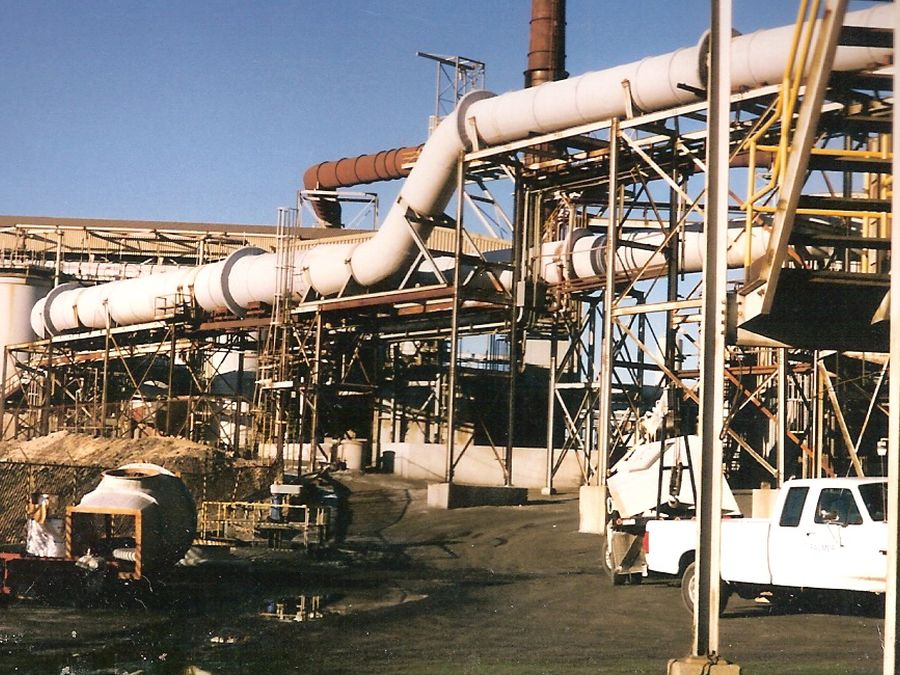
- Copper smelter off-gas systems in Texas, New Mexico and Arizona: 48, 72, 84, 96, 102 and 120 in. duct with dampers, expansion joints, transitions and flanges, including field installation at operating smelters.
- Chemical waste incineration plant, Nebraska: high-temperature duct system for 360 °F hydrochloric acid gas.
- Potash producer, New Mexico: duct, stacks, quench sections, venturi scrubbers and expansion joints for saturated, acidic gas.
- Glencore PASAR copper smelter, Philippines: FRP ductwork, weak-acid piping and cooling tower piping across the 2017–2024 shutdowns, with on-site FRP inspection and installation supervision.
- Biorem odor-control systems: round and rectangular duct, dampers and mist eliminators since 2018.
- WesTech: FRP hot acid piping and full-vacuum hot acid receivers for a project in Morocco, and FRP piping for Australia.
- Gold mine: PVC-lined FRP duct (dual laminate). US water treatment plants: rectangular FRP duct systems where chlorinated, humid air corrodes galvanized steel.
See also our FRP dampers and expansion joints, scrubbers and the scrubber and ductwork package case study.
Resins and datasheets
Materials & resins
We select the corrosion barrier and structural laminate for each service — Derakane™ epoxy vinyl ester and AROPOL™ isophthalic polyester systems — matched to the chemistry, temperature and abrasion of your process. Common choices and datasheets:
Derakane 411 — general corrosion · Derakane 470HT — high temperature · Derakane 510B — fire retardant (ASTM E84 flame spread 25) · Derakane 8084 — abrasion / elastomer-modified · AROPOL 7334T — isophthalic
FRP ductwork and piping: frequently asked questions
What temperature can FRP ductwork handle?
It depends on the resin and the gas, not on FRP as such. Standard bisphenol-A vinyl ester duct handles most smelter off-gas, scrubber and odor-control service; for hotter gas we move to novolac or high-temperature novolac vinyl ester, and we have supplied duct for 360 °F (182 °C) hydrochloric acid gas. The SMACNA wall tables apply up to 180 °F; above that the wall is calculated for the reduced strength at temperature.
How thick should an FRP duct wall be?
Start from the SMACNA Thermoset FRP Duct Construction Manual and then calculate: a 48 in. filament-wound duct, for example, starts at 0.220 in. for positive pressure, but vacuum, span, wind, seismic and accumulated solids often increase it. The total wall always includes the 0.100 in. corrosion liner, and the final thickness is confirmed by calculation for each project.
Round or rectangular FRP duct?
Round wherever the layout allows: it is filament wound, uses the least material for a given pressure and is the standard for large off-gas runs. Rectangular duct is contact-molded with external stiffeners and is used where space or connections require it, for example in water treatment plants.
Can FRP duct be fire retardant or electrically conductive?
Yes. Brominated vinyl ester laminates achieve an ASTM E84 Class I flame spread of 25 or less per the resin manufacturers’ data, confirmed by testing of the specified laminate where a rating is required. For static dissipation we add a carbon veil or conductive fillers to the corrosion barrier with grounding connections.
What about abrasive gas or slurry?
Add an abrasion-resistant liner where solids impinge, especially at elbows and transitions, and choose the resin for impact where needed. For one smelter off-gas duct carrying entrained solids, the resin manufacturer specified an abrasion-resistant liner in the impingement zones in addition to the 2.5 mm corrosion barrier.
What do you need to quote a duct or pipe system?
The gas or liquid composition with acid, chloride, fluoride and solvent concentrations; condensate chemistry; normal, maximum and upset temperatures; design pressure and vacuum including fan shut-off; flow or velocity and any solids. Then the internal sizes, a layout or isometric with lengths, the fittings list, flange standard and drilling, support spacing, indoor or outdoor, fire-retardant and conductivity requirements, site wind and seismic data, inspection points and delivery and installation scope.
Request a quote for FRP Ductwork & Piping
Send your drawings or service conditions and our engineers will spec it with you.