
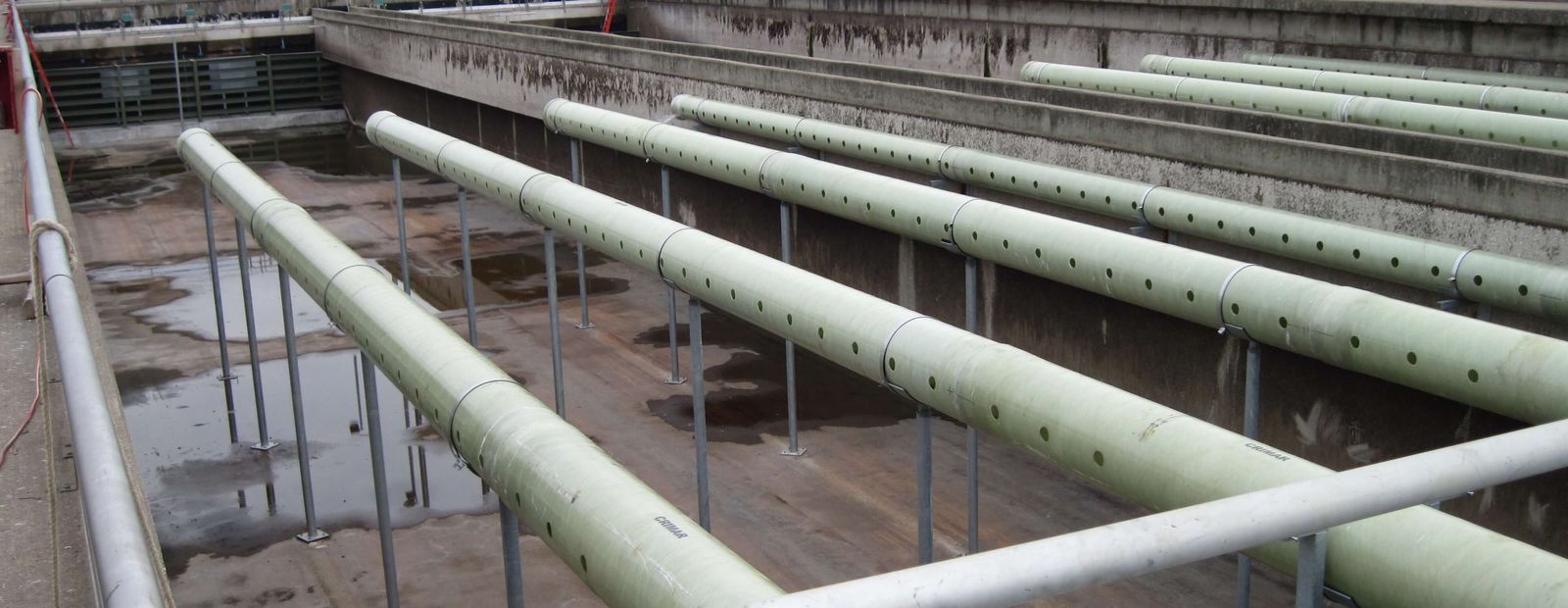
FRP for Water & Wastewater
Clarifiers, covers, internals, tanks and piping that never rust — for municipal, mining and industrial plants.
Crimar supplies FRP tanks, clarifier covers, launders, troughs, weirs, feedwells, liners, odor-control vessels, duct and piping to municipal, mining and industrial water-treatment plants, and works with OEMs such as Biorem and WesTech.
The challenge
Water and wastewater plants combine hydrogen sulfide, chlorine and treatment chemicals with constant moisture. Odor has to be contained, clear-span covers must seal aggressive tanks, internals have to hold their geometry for decades, and potable water must not pick up contaminants from the tank. Galvanized and coated steel corrode in chlorinated, humid air.
FRP equipment for water treatment
| Equipment | What we supply |
|---|---|
| Potable and process water tanks | Shop-built and field-assembled tanks, designed to AWWA D120 and ASME RTP-1 with FDA 21 CFR 177.2420 resins for potable water |
| Odor control | Biotrickling filter vessels, carbon adsorber tanks, multi-stage rectangular tanks, duct, dampers and mist eliminators |
| Chemical storage and dosing | Insulated double-wall tanks, for example for aluminum sulfate |
| Clarifiers and internals | FRP clarifiers, feedwells, launders, troughs and weirs; lamella plate packs |
| Covers | Clarifier and tank covers for odor containment, such as a 60 ft diameter clarifier cover |
| Liners | Bonded 6 mm FRP segments for concrete and steel basins; field-applied FRP linings on steel |
| Duct and piping | Round and rectangular FRP duct for treatment buildings; FRP process and effluent piping |
Project record
- 350,000-gallon potable water tank, Arizona: 32 ft 10 in. diameter × 55 ft 3 in. sidewall, seismic zone 2A, designed to ASME RTP-1 and AWWA D120 with FDA-compliant resins, handling more than 1,000,000 gallons a day; independent water tests showed no detectable contaminants. More on FRP tanks.
- Biorem odor-control systems (US and Canada, since 2010): a 12 ft diameter, 106 m³ biofilter vessel to ASTM D3299 / D4097 (2024); carbon adsorber tanks to ASTM D4097 and ASME RTP-1 for 24 in. WC at 40 °C (2025); multi-stage rectangular tanks; duct and dampers.
- WesTech: launder systems for two 73.2 m diameter thickeners in Puerto Rico; feedwells, troughs and draft tubes for Australia; drip trays, covers and a feed tank system in the USA.
- Water treatment plant, Colorado: a hot-water clean-in-place tank in service for about 20 years.
- US water treatment plants: rectangular FRP duct systems; California: a 25 ft FRP clarifier.
Standards
| Standard | Applies to |
|---|---|
| AWWA D120; FDA 21 CFR 177.2420 | Potable water tanks and resins |
| ASME RTP-1; ASTM D3299 / D4097 | Tanks and vessels; RTP-1 for pressure, vacuum and hazardous service |
| SMACNA Thermoset FRP Duct Construction Manual | Odor-control and ventilation duct |
How we work with water treatment plants and OEMs
Crimar mainly builds to the drawings and specifications of the end user and their engineering company, and adds the design input that is specific to FRP: resin and corrosion-barrier selection, laminate thickness, stiffening, nozzles, flanges, thermal expansion and supports. Every project runs on an inspection and test plan with hold and witness points and ends with a Manufacturing Data Record. We make FRP equipment in the USA, Mexico and China depending on the project, to Crimar’s specifications, and install it or supervise installation on site where needed.
Most of our water treatment work is built for equipment OEMs to their drawings: odor-control vessels for Biorem, clarifier internals and covers for WesTech. For plant owners, we design and build tanks, covers and liners to the plant’s specification, and for potable water we add AWWA D120 design, FDA-compliant resins and a post-cure and water test before the tank enters service.
What we need to quote
- What the tank or cover holds: water, treatment chemicals, hydrogen sulfide or chlorine exposure, temperature
- Dimensions or capacity, drawings and the applicable standard
- For covers: tank diameter, rim details, wind and snow loads, hatches and vents
- For potable water: required certifications and water testing
- Site, seismic data, delivery and installation scope
FRP for water and wastewater: frequently asked questions
Can FRP tanks be used for potable water?
Yes. Our 350,000-gallon potable water tank was designed to AWWA D120 and ASME RTP-1 with resins acceptable under FDA 21 CFR 177.2420, steam-cured on site, and independent water samples showed no detectable contaminants before it entered service.
Why FRP for odor-control equipment?
Because hydrogen sulfide and moist air corrode steel, while an FRP vessel or duct has its corrosion barrier built in. We build biofilter vessels, carbon tanks, duct and dampers for Biorem odor-control systems.
Can you line an existing concrete basin instead of replacing it?
Yes, when the structure is sound: shop-made 6 mm FRP wall and floor segments are bonded inside the basin with FRP corner sections and field-bonded joints.
How long do FRP water tanks last?
Typically 20 to 30 years or more when the resin suits the service and the tank is inspected regularly; one of our hot-water tanks at a Colorado water treatment plant has been in service for about 20 years.
Do you supply clarifier internals for existing clarifiers?
Yes: feedwells, launders, troughs, weirs and lamella plate packs, built to the clarifier OEM’s drawings or to measurements of the existing tank.
Do you supply odor-control equipment directly to plants?
Mostly through odor-control system suppliers such as Biorem, for whom we build biofilter vessels, carbon tanks, multi-stage rectangular tanks, duct and dampers; plants can also buy FRP tanks, duct and covers from us directly.
Can FRP covers be removed for maintenance?
Yes. Covers are made of bolted, gasketed panels, and sections near drives and equipment can be designed to be removed individually for access.
What is the difference between a biotrickling filter vessel and a carbon adsorber tank?
Both are odor-control vessels. A biotrickling filter holds a media bed where microorganisms break down hydrogen sulfide, kept wet by recirculating water; a carbon adsorber holds activated carbon that adsorbs odorous compounds. Both are built in FRP because the air they treat is moist and corrosive; we have built both for Biorem.