
FRP Tanks & Vessels
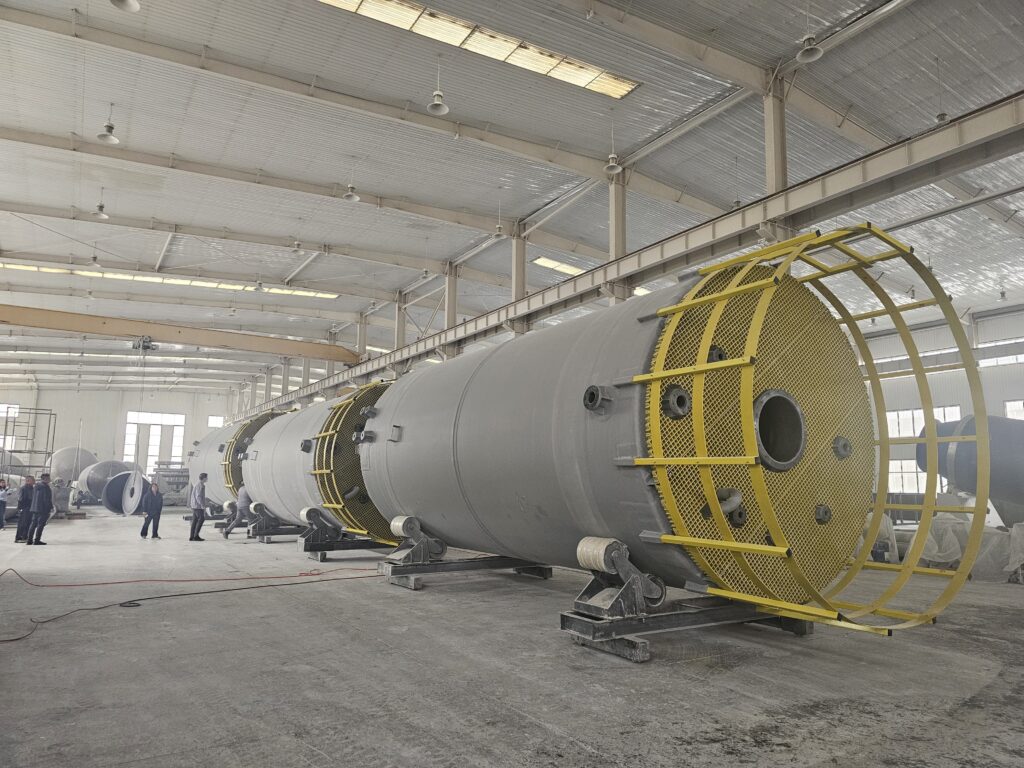
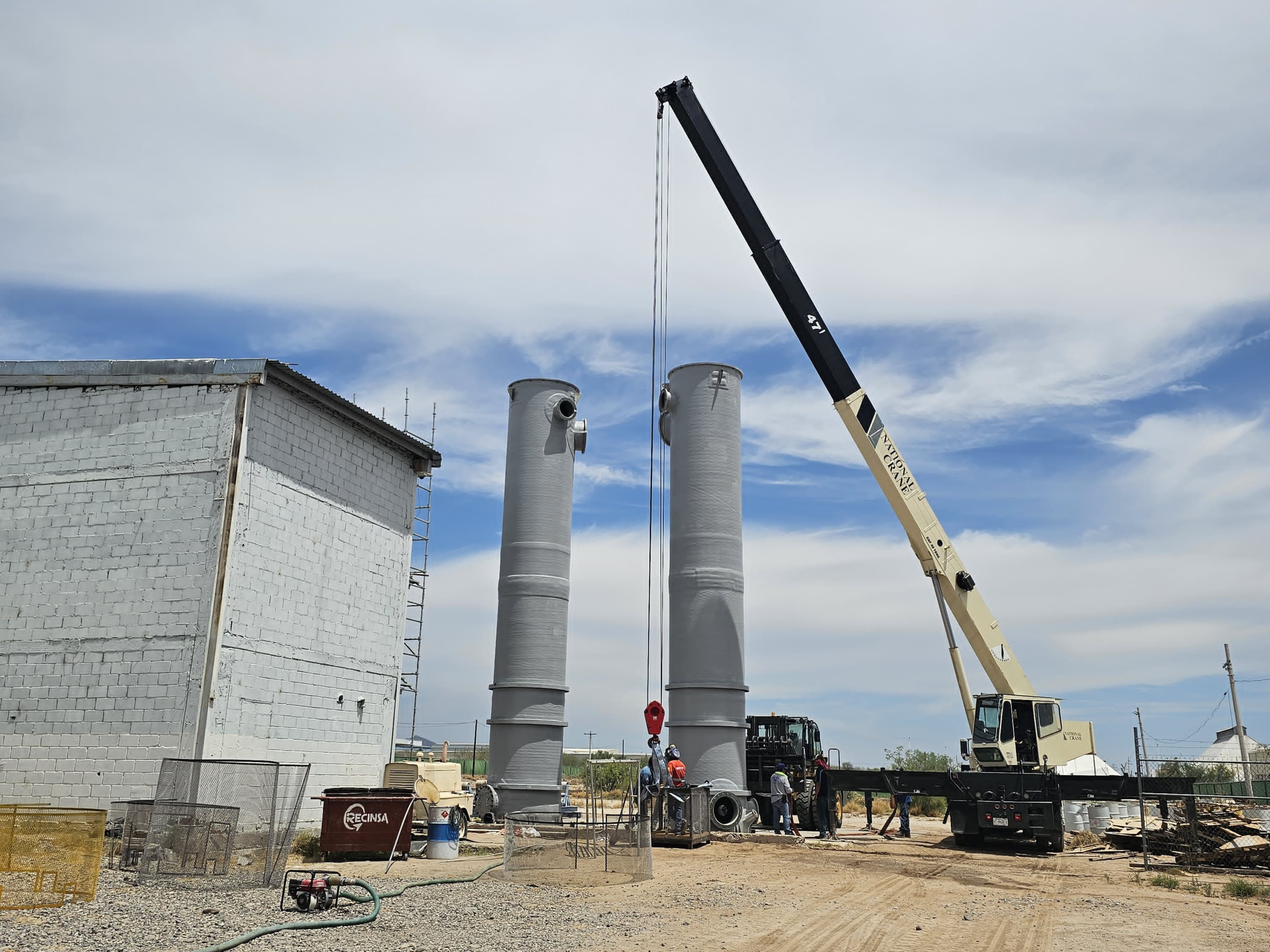
Crimar designs and fabricates FRP tanks and process vessels for storage, mixing, reaction and separation duties across mining, chemical and water-treatment plants. From compact pump tanks to 15-meter-diameter storage tanks, each vessel is engineered to its contents, temperature and pressure — shop-fabricated by hand lay-up and filament winding, or field-wound and assembled on site where transport limits size.
FRP tank and vessel specifications
These are the ranges we build to. Every tank is engineered to its own contents, temperature, pressure and site loads, so the figures for your tank come from its design calculation.
| Parameter | Range and options |
|---|---|
| Diameter | Shop-built and shipped whole up to about 4.5 m (DN4500). Larger tanks are shop-built and oblated for field assembly, or wound on site with a field winder, up to 15 m. |
| Capacity | From process vessels of about 1 m³ to field-assembled storage tanks of 350,000 US gal (about 1,325 m³). |
| Shape and heads | Vertical, horizontal, rectangular and underground. Flat, dished, conical or sloped bottoms. Flat, dished or removable top heads. |
| Design pressure | Atmospheric and low-pressure tanks to ASTM D3299 / D4097 (recent deliveries were designed for 17.5 and 24 in. WC). Vessels to ASME RTP-1 up to 15 psig internal or external; above 2 psig RTP-1 requires a proof test of the as-built laminate. |
| Design temperature | Set by the resin and the chemistry. Up to 180 °F (82 °C) is the range with the most published design and chemical-resistance data; above that, ASME RTP-1 calls for special design attention and resin-manufacturer review, and we move to high-temperature resins such as novolac vinyl ester. |
| Fabrication method | Filament winding, contact molding (hand lay-up and spray-up) and on-site field winding. |
| Corrosion barrier | Resin-rich inner surface reinforced with a surfacing veil, 0.01–0.02 in. (0.25–0.5 mm), followed by at least two plies of chopped-strand glass; combined thickness not less than 0.10 in. (2.5 mm), per ASME RTP-1. Glass, synthetic (polyester) or carbon / graphite veils. |
| Structural laminate | Calculated for the loads and varied along the shell. Example: 2.11 in. at the bottom knuckle, tapering to 0.39 in. at the top of a 32 ft 10 in. diameter tank. |
| Resin systems | Bisphenol-A epoxy vinyl ester (Derakane 411), novolac vinyl ester (Derakane 470HT), fire-retardant vinyl ester (Derakane 510 series), elastomer-modified vinyl ester (Derakane 8084), isophthalic polyester (AROPOL 7334T). Dual-laminate with PP, PVC, PVDF or ECTFE liners. |
| Accessories | Flanged nozzles, manways, ladders, platforms, lifting lugs, tie-down lugs, level indicator stripe, factory insulation, UV-protected and fire-retardant exteriors. |
| Inspection and records | Visual, laminate thickness, Barcol hardness, acetone test, dimensional check and hydrostatic test; Manufacturing Data Record (MDR) with material certificates; third-party witness by BV, Moody, ABS or the client’s inspector. |
| Where we build | Our own FRP plants in the USA and Mexico and a long-term manufacturing partner in China; field fabrication and installation managed from Tucson, Arizona. |
Where our tanks are used
- Mining and hydrometallurgy: sulfuric acid and SX-EW electrolyte storage, SX mix tanks, pump and feed tanks, acid wash columns and dilute HCl tanks for gold ADR plants, neutralization and reagent tanks. See solvent extraction and mining and mineral processing.
- Smelting and refining: scrubber sumps, quench vessels and hot acid overflow tanks. See smelting and refining.
- Water and wastewater: potable and process water storage, chemical dosing and storage tanks such as insulated double-wall aluminum sulfate tanks, biofilter and carbon adsorber vessels for odor control. See water and wastewater.
- Chemical processing: neutralization and reaction tanks, dilute hydrochloric acid tanks, vacuum filtrate receivers and gas separators. See chemical, oil and gas.
Which standard applies: ASME RTP-1, ASTM D3299 or D4097
The standard decides how the tank is designed, how much is documented and what is inspected, so it should be fixed before quoting. In short: ASME RTP-1 covers pressure and vacuum vessels up to 15 psig and corrosive or hazardous service where the owner wants a fully documented design; ASTM D3299 and D4097 cover atmospheric and low-pressure storage tanks by fabrication method.
| Standard | What it covers | Typical use |
|---|---|---|
| ASME RTP-1 | Stationary vessels that store or process corrosive substances at up to 15 psig internal and/or external pressure above the hydrostatic head. | Pressure or vacuum service, hazardous contents, or any project whose specification calls for RTP-1. Excludes ducts, stacks, internals, piping and fully buried closed vessels. |
| ASTM D3299 | Filament-wound glass-fiber-reinforced thermoset resin corrosion-resistant tanks. | Above-ground storage and process tanks built by filament winding. |
| ASTM D4097 | Contact-molded glass-fiber-reinforced thermoset resin corrosion-resistant tanks. | Hand lay-up or spray-up tanks, and the heads, bottoms and nozzles of wound tanks. |
| BS EN 13121 / BS 4994 | GRP tanks and vessels for use above ground (EN 13121); design and construction of vessels and tanks in reinforced plastics (BS 4994). | Projects engineered to European or British codes. |
| AWWA D120 + FDA 21 CFR 177.2420 | Thermosetting fiberglass-reinforced plastic tanks for water; resins acceptable for repeated contact with food. | Potable-water and food-grade storage. |
ASME RTP-1 sets hard pressure limits. A vessel may be rated up to 15 psig (103 kPag) internal or external only if the as-constructed laminate is proof tested; without a proof test the limit is 2 psig (14 kPag). The standard also requires a User’s Basic Requirements Specification, in which the owner or engineer states the contents, design pressure and temperature, vacuum cases and loads, and it fixes the minimum corrosion barrier: a veil-reinforced resin-rich surface of 0.01–0.02 in. followed by chopped-strand glass, at least 0.10 in. (2.5 mm) in total. RTP-1 does not cover ducts, stacks, vessel internals or piping, which are designed to their own standards.
Our quality records state the design basis of each tank. A 12 ft diameter biofilter vessel delivered to Biorem in 2024, for example, was designed to ASTM D3299 and D4097 for 17.5 in. WC positive pressure at ambient temperature; a carbon adsorber tank delivered to Biorem in 2025 was designed to ASTM D4097 and ASME RTP-1 for 24 in. WC at 40 °C. For potable water we add AWWA D120 and FDA 21 CFR 177.2420 resin compliance.
How we build: filament winding, contact molding and field winding
Filament winding
Continuous glass roving wetted with resin is wound over a rotating mandrel at a controlled angle. Winding gives the shell high hoop strength with a consistent glass content, which makes it the usual method for cylindrical storage tanks and the shells of larger vessels. Heads, bottoms, nozzles and attachments are then contact-molded and bonded to the shell.
Contact molding: hand lay-up and spray-up
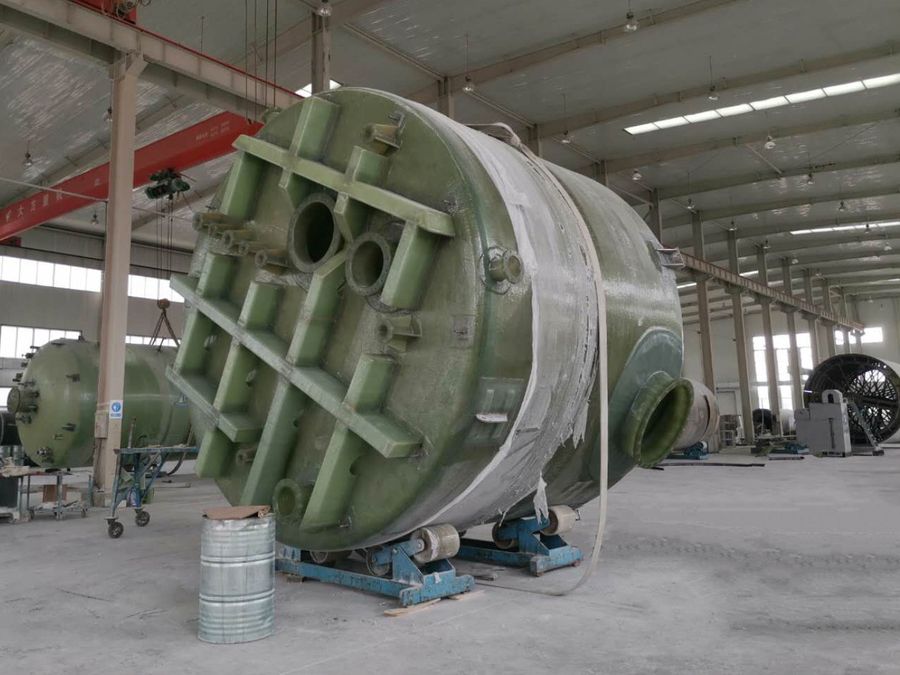
Chopped-strand mat, woven roving and veil are laid up by hand on a mold, or chopped glass and resin are sprayed on and rolled out. Contact molding suits rectangular tanks, cone bottoms, complex nozzle arrangements and one-off vessels with internals, such as acid wash columns and multi-stage rectangular biofilter tanks.
Large tanks: oblated shipment or on-site winding
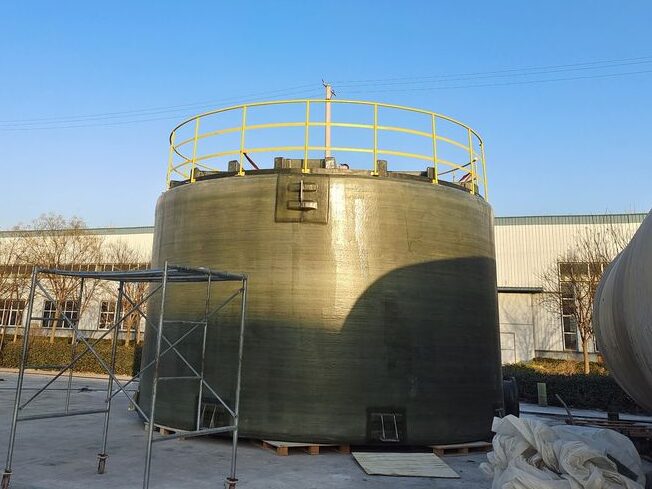
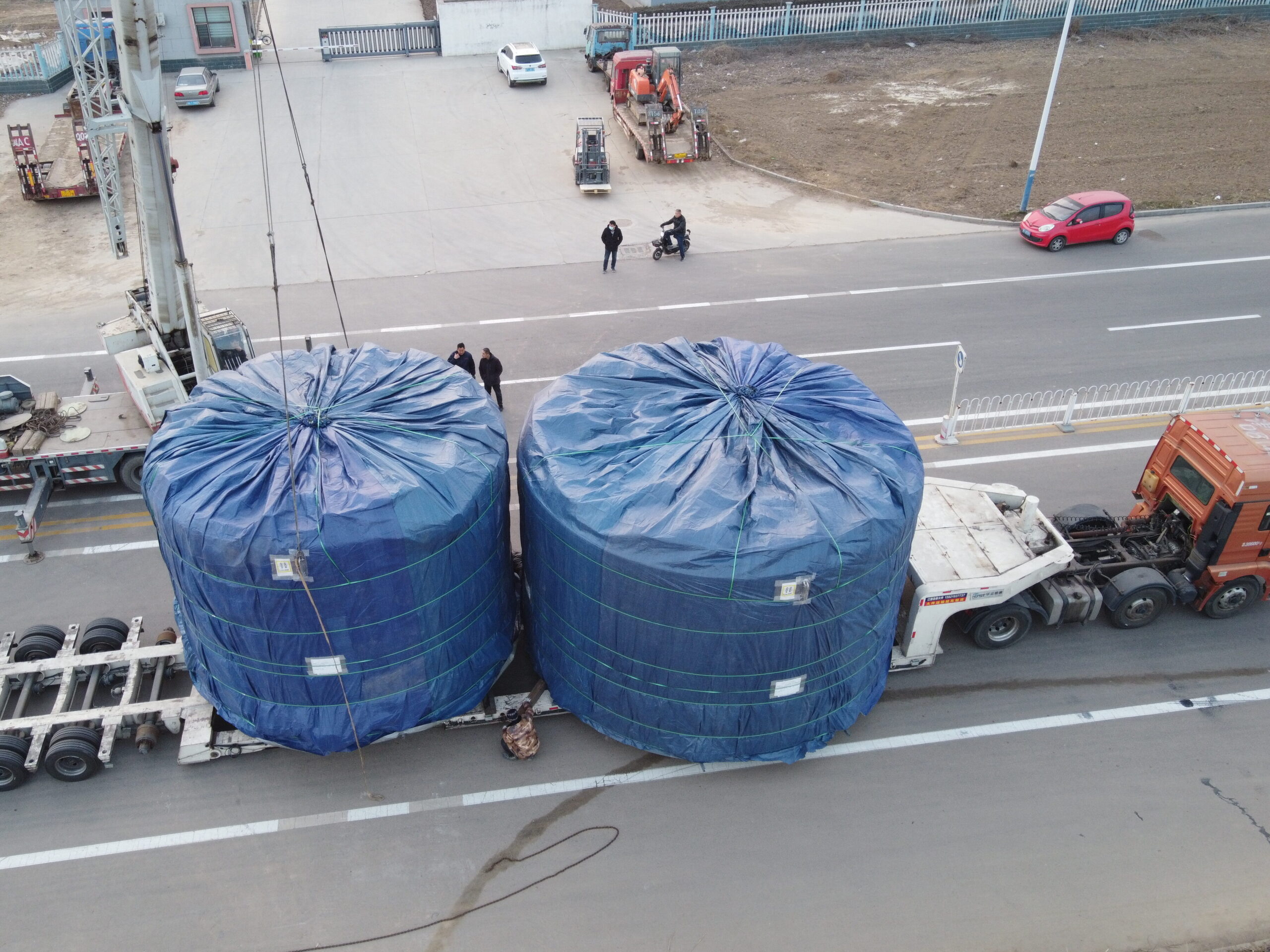
Road transport limits a finished tank to about 4.5 m in diameter. Above that there are two routes. Shop-built tanks can be oblated, pressed into an oval for shipping, and their heads shipped in sections for field bonding; this practice began in North America in the 1960s. It keeps fabrication in a controlled shop, out of the wind, rain and direct sun that cause defects in outdoor laminating, and reduces costly on-site labor. Alternatively we wind the tank on site: shipping costs less, and a shell up to 12 m high can be wound in one piece without a joint, which is faster when many tanks of the same diameter are needed. A field winder for 10–15 m diameter tanks needs about 25 × 18 m of flat, hard ground; one for tanks under 10 m needs about 20 × 13 m, with temporary workshops 9–12 m high.
Laminate construction
Every wall has two parts. The corrosion barrier faces the contents: a resin-rich surface reinforced with a glass, synthetic or carbon veil, backed by chopped-strand plies, which together stop the chemistry from reaching the structural glass. The structural laminate behind it carries the hydrostatic, wind, seismic and nozzle loads, and its thickness is calculated and varied along the shell. On our 350,000-gallon tank the wall ran from 2.11 in. at the bottom knuckle to 0.39 in. at the top. Where a heater or hot gas creates sudden temperature changes, we use a graphite veil and graphite-filled resin in the barrier so heat spreads into the structure instead of blistering the liner.
Resins and datasheets
Materials & resins
We select the corrosion barrier and structural laminate for each service — Derakane™ epoxy vinyl ester and AROPOL™ isophthalic polyester systems — matched to the chemistry, temperature and abrasion of your process. Common choices and datasheets:
Derakane 411 — general corrosion · Derakane 470HT — high temperature · Derakane 510B — fire retardant (ASTM E84 flame spread 25) · Derakane 8084 — abrasion / elastomer-modified · AROPOL 7334T — isophthalic
Resin selection starts from the manufacturer’s chemical-resistance data for your exact medium, concentration and temperature. We often combine resins in one wall: on a 350,000-gallon potable water tank we used an FDA-compliant vinyl ester (Derakane 411) in the corrosion barrier and an FDA-compliant isophthalic polyester in the structural layers.
Inspection and release testing
Each tank is released against a written inspection and test plan, and its results go into the Manufacturing Data Record. The criteria below are the ones we apply; the right-hand column shows the actual results for a 12 ft (3,658 mm) diameter × 39 ft (11,973 mm), 106 m³ filament-wound vessel released from our Mexico plant in June 2024.
| Check | Acceptance criterion | Result on a 106 m³ vessel |
|---|---|---|
| Laminate thickness | Not less than 100 % and not more than 135 % of the design value at every measured point | Shell 0.49–0.54 in. measured vs. 0.45–0.53 in. design |
| Barcol hardness | At least 90 % of the resin manufacturer’s value for a clear casting (ASME RTP-1) | Average 40.3 vs. 40 specified |
| Inside diameter | ±1 % | 144.37 / 143.87 in. measured vs. 144 in. drawing |
| Overall length | ±0.5 % | 470.5 in. measured vs. 471.37 in. drawing |
| Nozzle and flange alignment | ±3 mm angular deviation | Within tolerance |
| Cure (acetone test) | No surface tackiness (ASTM C582) | Passed |
| Visual | Smooth inner surface, no exposed fiber, cracks, delamination or dry spots | Minor surface defects found and repaired before release |
Where the specification calls for it, tanks are hydrostatically tested in the shop or after field assembly before they enter service. Client and third-party inspectors (BV, Moody, ABS) can witness any hold point. See our quality and inspection process.
Project record
350,000-gallon potable water tank, Arizona
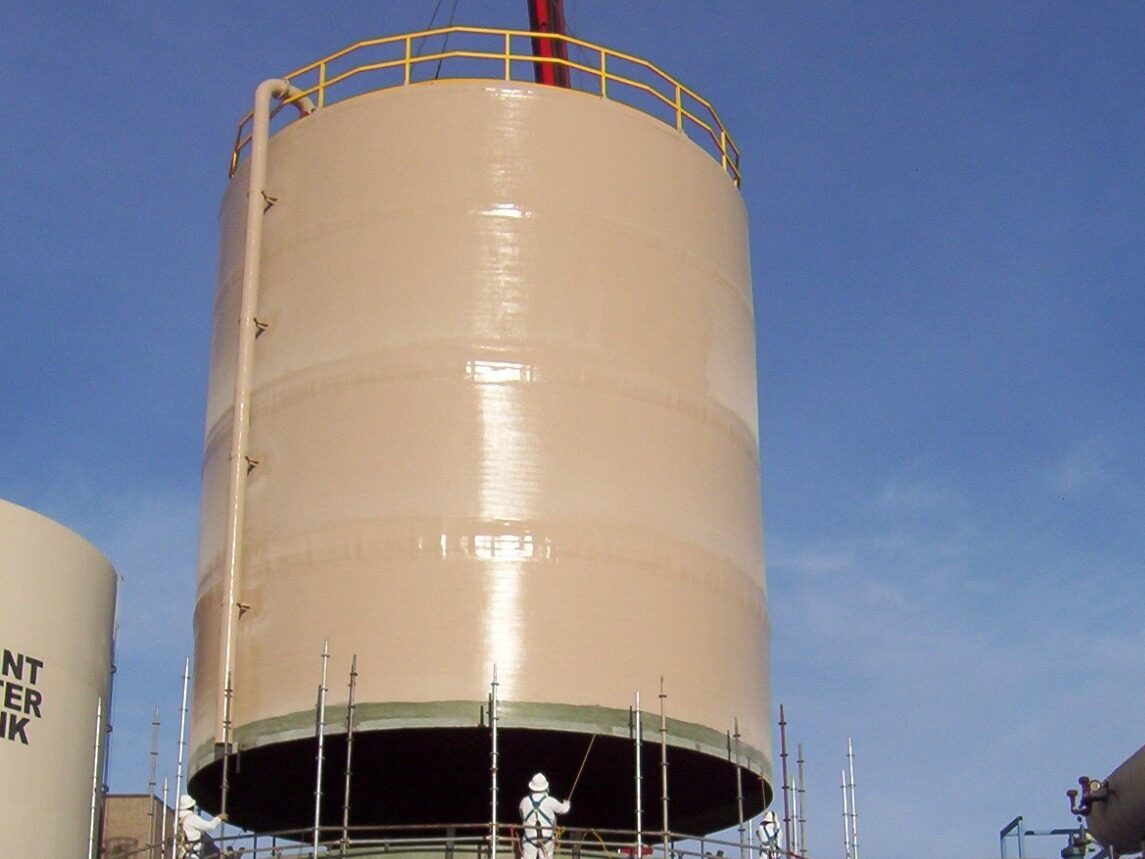
A pharmaceutical manufacturer needed a rinse-water tank handling more than 1,000,000 gallons of potable water a day. The tank is 32 ft 10 in. in diameter with a 55 ft 3 in. sidewall, in seismic zone 2A, and was designed to ASME RTP-1 and AWWA D120-02 with FDA 21 CFR 177.2420 resins. A composites engineer on the ASME RTP-1 committee stamped the design calculations. The walls were built in sections, post-cured at 200 °F, oblated and trucked about 1,500 miles to site, then bonded, steam-cured for 16 hours at 160–180 °F and hydro-tested. Independent water samples showed no detectable contaminants, and FRP cost less than the stainless-steel alternative.
98 FRP vessels for a precious metals recovery plant in Indonesia
For Freeport-McMoRan and Hatch, completed in 2024: 98 FRP vessels, with tanks from 4 to 16 ft in diameter, shop-fabricated in China under Crimar quality control.
125 tanks for a zinc recovery plant in California
For a geothermal zinc recovery plant engineered by Jacobs, completed in 2001: 125 FRP tanks from 4 to 22 ft in diameter, with on-site assembly and the associated FRP piping systems.
Acid wash columns and dilute HCl tanks for gold plants
Since 2016 we have supplied FLSmidth gold projects with ASME RTP-1 acid wash columns of 28 m³ and dilute hydrochloric acid tanks of 21–36 m³ in Derakane 411. Read the acid wash vessel case study, or see our full project record.
FRP tank selection: frequently asked questions
How large can an FRP tank be?
Up to 15 m (about 49 ft) in diameter. Tanks up to about 4.5 m ship whole by road. Larger tanks are either built in the shop and oblated (flattened into an oval) for shipping and bonded together on site, or wound on site with a field winder. The largest tank in our record is a 350,000-gallon potable water tank, 32 ft 10 in. in diameter with a 55 ft 3 in. sidewall.
What pressure and vacuum can an FRP vessel take?
Up to 15 psig internal or external under ASME RTP-1, provided the as-built laminate is proof tested; without a proof test RTP-1 limits the vessel to 2 psig. Most storage tanks are atmospheric or a few inches of water column; for example, a recent filament-wound biofilter vessel was designed for 17.5 in. WC positive pressure. Vacuum from pump-down, draining or cool-down must be stated in the design data, because it often governs shell and head thickness.
What is the maximum operating temperature for an FRP tank?
It depends on the resin and the chemistry, not on FRP as such. Up to 180 °F (82 °C) is the range where the most design and chemical-resistance data exist; above that ASME RTP-1 requires the designer to account for reduced strength at temperature, and we use high-temperature resins such as novolac vinyl ester and confirm the selection with the resin manufacturer. Where hot liquid or steam enters through a nozzle or heater, we protect the zone with a PTFE sleeve and a graphite veil with graphite-filled resin to spread the heat and avoid thermal-shock blistering.
Should I specify ASME RTP-1 or ASTM D3299 / D4097?
Specify ASME RTP-1 when the vessel sees pressure or vacuum, holds hazardous contents, or your plant standard requires it; ASTM D3299 (filament-wound) or D4097 (contact-molded) is usually enough for atmospheric storage. RTP-1 adds a formal user’s design specification, documented design calculations and stricter fabrication and inspection records. We design and fabricate to whichever standard your specification names.
Is FRP a better choice than stainless steel or rubber-lined steel for acid service?
For hydrochloric acid, chlorides and dilute sulfuric acid, usually yes. Chlorides cause pitting and crevice corrosion in stainless steel even at low concentrations. Rubber-lined carbon steel works while the lining is intact, but it is heavy and the lining has to be inspected and repaired for the life of the tank. An FRP tank’s corrosion barrier is part of the wall, engineered for the specific chemistry, so there is no separate coating to fail. For a 350,000-gallon potable water tank, FRP also cost less than stainless steel.
How long does an FRP tank last?
Typically 20 to 30 years or more, when the resin and corrosion barrier are matched to the chemistry and temperature and the tank is inspected regularly. Service life is set by the chemistry, temperature, abrasion and thermal cycling, not by the fiberglass itself. A hot-water clean-in-place tank we supplied to a Colorado water treatment plant has been in service for about 20 years, and the American Composites Manufacturers Association reports six Derakane 411 vinyl ester leachate tanks at a Florida landfill that have run for more than 30 years without repairs. When FRP tanks fail early, it is usually at the corrosion barrier, from the wrong resin, overheating or thermal shock. That is why we select the barrier for the actual service and recommend an annual internal inspection with Barcol hardness readings.
What resin should I use?
Bisphenol-A epoxy vinyl ester (Derakane 411) covers most acids, alkalis and bleaches at moderate temperature and is our default for mining and water-treatment tanks. Novolac vinyl ester (Derakane 470HT) is for higher temperatures, strong acids, oxidizers and solvents; a brominated vinyl ester (Derakane 510 series) where a fire-retardant laminate is required; elastomer-modified vinyl ester (Derakane 8084) for abrasion and impact; and isophthalic polyester for less aggressive service such as process water. Final selection is confirmed against the resin manufacturer’s chemical-resistance data for your exact concentration and temperature.
What information do you need to quote an FRP tank?
The contents and their concentration, specific gravity, design and operating temperature and pressure (including vacuum), and the diameter, height or capacity. We also need the nozzles, internals, agitator loads, ladders and platforms, and the site’s seismic, wind and snow loads. Abrasion, agitation, the number of nozzles and the choice of filament winding or hand lay-up all change the price, so the more complete the data, the firmer the quote. Our Tank Data Request Form lists every item.
What documentation comes with a Crimar tank?
A Manufacturing Data Record (MDR) with the qualification certificate, material certificates, laminate thickness, Barcol hardness, acetone and dimensional reports, hydrostatic test results and as-built data. We follow the inspection and test plan in your specification and accommodate third-party or client inspectors (BV, Moody, ABS) at hold points.
Request a quote for FRP Tanks & Vessels
Send your drawings or service conditions and our engineers will spec it with you.