Projects · Gold Processing · FRP Process Vessels
FRP Acid Wash Vessels for Gold ADR & Carbon Elution Plants
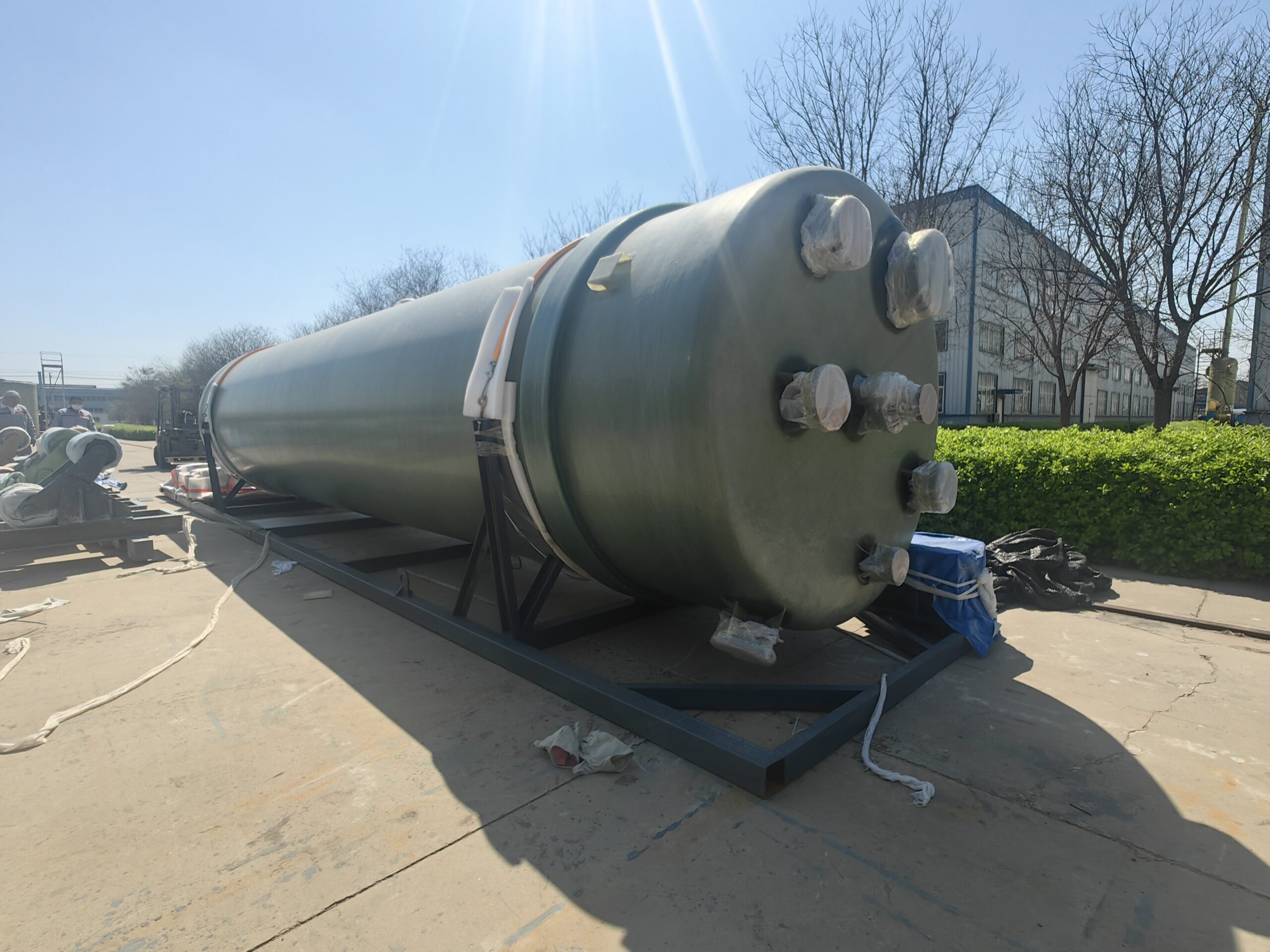
Custom fiberglass acid wash vessels and columns for the carbon stripping circuit, designed to ASME RTP-1 for dilute hydrochloric acid service. Crimar has built acid wash columns for FLSmidth gold projects since 2016, and fabricates them in Hermosillo, Mexico or in China with the inspection records and documents an OEM package requires.
2016
Supplying FRP acid wash columns to FLSmidth gold projects
RTP-1
ASME design and fabrication standard for our acid wash vessels
≈10 t
Carbon batch of our most recent delivered vessel
MX + CN
Two fabrication bases, one contract managed from Tucson, Arizona
What an acid wash vessel does in a gold ADR circuit
In carbon-in-leach (CIL) and carbon-in-pulp (CIP) gold plants, loaded activated carbon picks up calcium carbonate, magnesium salts and other inorganic scale along with the gold. Left in place, that scale blocks the carbon’s pores, lowers stripping efficiency in the elution column and reduces the carbon’s activity when it goes back to the leach tanks. The acid wash vessel is where each batch of carbon is cleaned with dilute hydrochloric acid, usually about 3% HCl, before it is stripped.
A typical sequence runs like this; details vary with the circuit designer and the plant:
- Transfer in. Loaded carbon arrives from the loaded-carbon screen and fills the vessel as a batch.
- Acid wash. Dilute HCl is pumped through the carbon bed, typically upflow, then circulated or left to soak so the scale dissolves.
- Rinse. Fresh water displaces the spent acid, sometimes followed by a caustic neutralization step.
- Transfer out. The washed carbon is educted or pumped out through the cone to the elution (strip) column.
That duty is harder on a vessel than it looks: chloride-bearing acid, an abrasive carbon slurry at every transfer, repeated fill-and-drain cycles and HCl vapor at the vent. The vessel has to hold its shape and its corrosion barrier through thousands of batches, keep every grain of carbon inside the outlet screens, and drain completely through the cone.
Why FRP is the standard material for acid wash vessels
Stainless steel is a poor fit for hydrochloric acid: chlorides cause pitting and crevice corrosion even at low concentrations. Rubber-lined carbon steel works while the lining is intact, but it is heavy, and the lining has to be inspected and repaired for the life of the vessel. A properly specified vinyl ester FRP vessel resists dilute HCl through its full wall, with no lining to fail.
| FRP (vinyl ester) | Rubber-lined carbon steel | 316L stainless steel | |
|---|---|---|---|
| Dilute HCl service | Excellent, with resin selected for the duty | Good while the lining is intact | Not recommended: chloride pitting and crevice attack |
| Ongoing maintenance | No lining or coating to maintain | Periodic lining inspection and repair | Corrosion monitoring |
| Weight to ship and lift | Lightest | Heaviest | Heavy |
| Nozzles and internals | Laminated in as one corrosion-resistant piece | Each nozzle lined separately | Welded, same chloride limits |
How we build an acid wash vessel
Every vessel is built to the purchaser’s drawings and scope sheet or, where there are none, to a design we develop from the carbon batch size and wash sequence. The features below are what a typical gold-plant acid wash vessel includes.
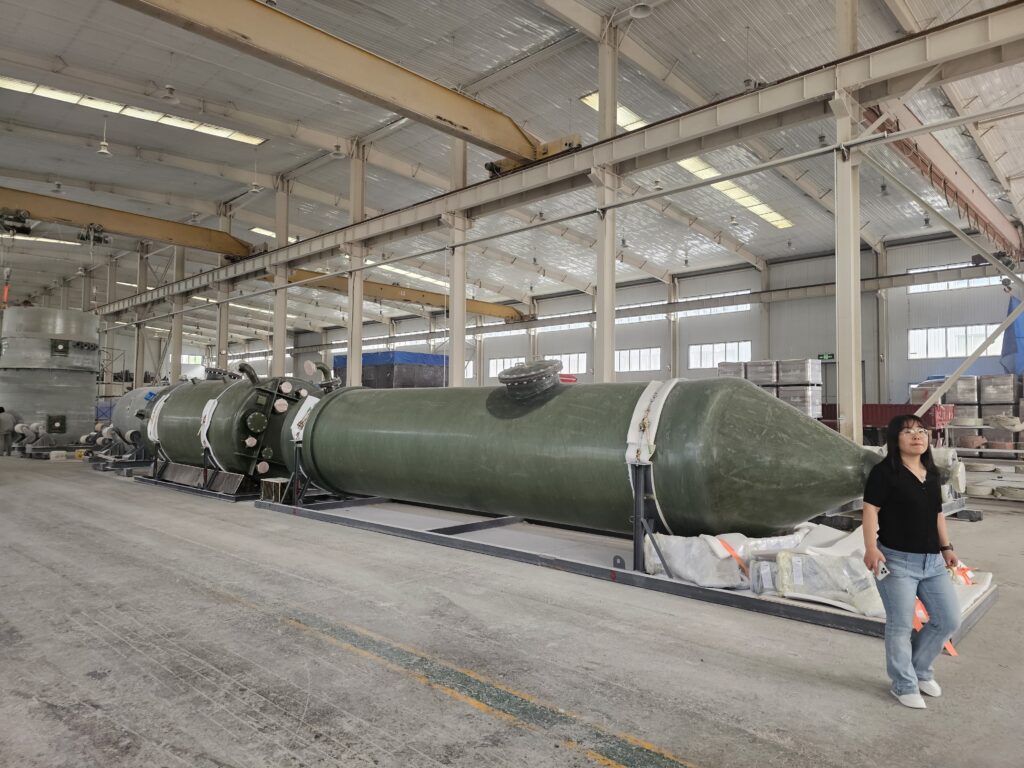
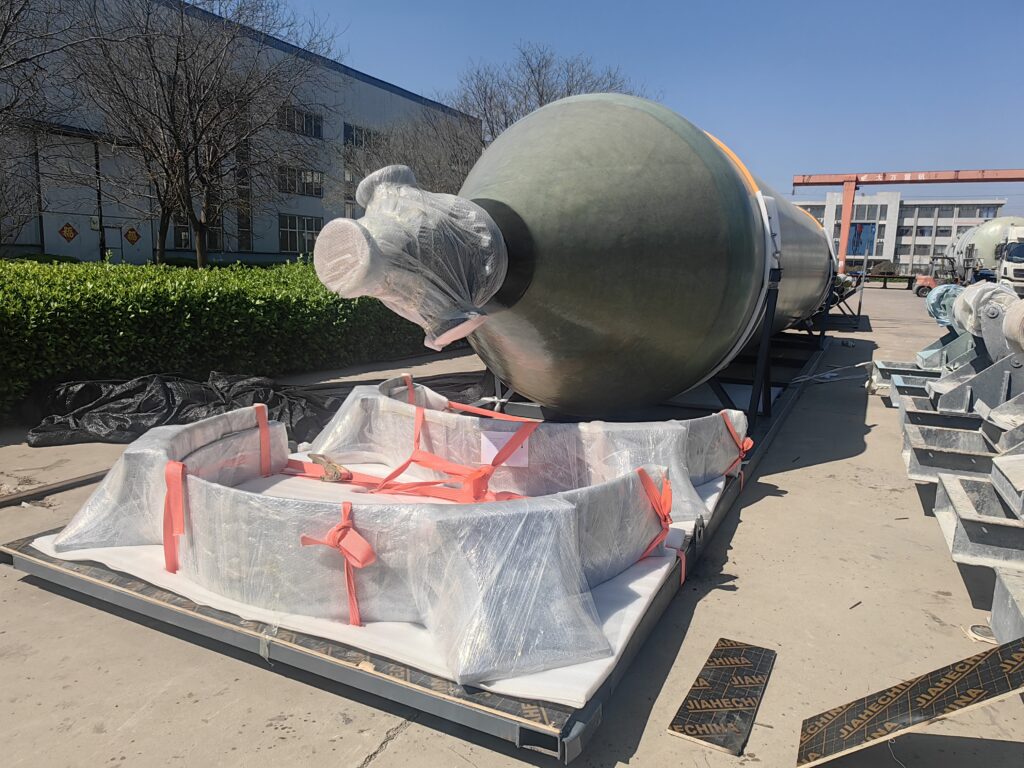
- Geometry. Tall cylindrical column, commonly around 5:1 height to diameter, with a flat or dished top and a 60° cone bottom so the carbon drains out completely.
- Corrosion barrier. A veil-rich inner layer, typically about 3 mm (1/8 in) of synthetic surfacing veil and chopped-strand mat, backed by a structural laminate sized by calculation.
- Resin. Premium bisphenol-A epoxy vinyl ester (Derakane 411 class) for ambient washes; novolac vinyl ester (Derakane 470 class) where the acid runs hot.
- Carbon retention. Wedge-wire lateral outlet screens in Hastelloy C-276, stainless steel or FRP. We supply them, or install screens free-issued by the OEM.
- Process connections. Acid inlet and distribution, spray nozzles, overflow, vent, drain, carbon transfer, manways and instrument nozzles, all laminated into the shell.
- Supports and handling. Lifting lugs, hold-down lugs, legs or skirt, and a steel shipping skid, with certified stainless fasteners where the specification calls for them.
- Engineering. Design calculations to ASME RTP-1 (or BS EN 13121, or the project specification), stamped by a licensed Professional Engineer when required.
Typical design envelope
Representative ranges for gold-plant acid wash vessels. Every vessel is sized and calculated for its own project.
| Carbon batch | Typically 5 to 10+ tonnes per wash; other sizes on request |
| Inside diameter | About 1.5 to 2.5 m (5 to 8 ft) |
| Shell height | Up to about 9 m (30 ft), shop-built and shipped in one piece |
| Top / bottom | Flat or dished top; 60° cone bottom (other angles on request) |
| Service | Dilute HCl, typically about 3–5%, with activated-carbon slurry; ambient or heated per resin selection |
| Pressure | Atmospheric and vented; designed for full hydrostatic load |
| Design code | ASME RTP-1, BS EN 13121 or project specification |
| Inspection | Material certificates, laminate thickness, Barcol hardness and acetone cure checks, dimensional and nozzle-location checks, visual; hydrotest where specified |
| Documentation | Inspection & Test Plan, approval drawings, calculations and a full Manufacturing Data Record (MDR) |
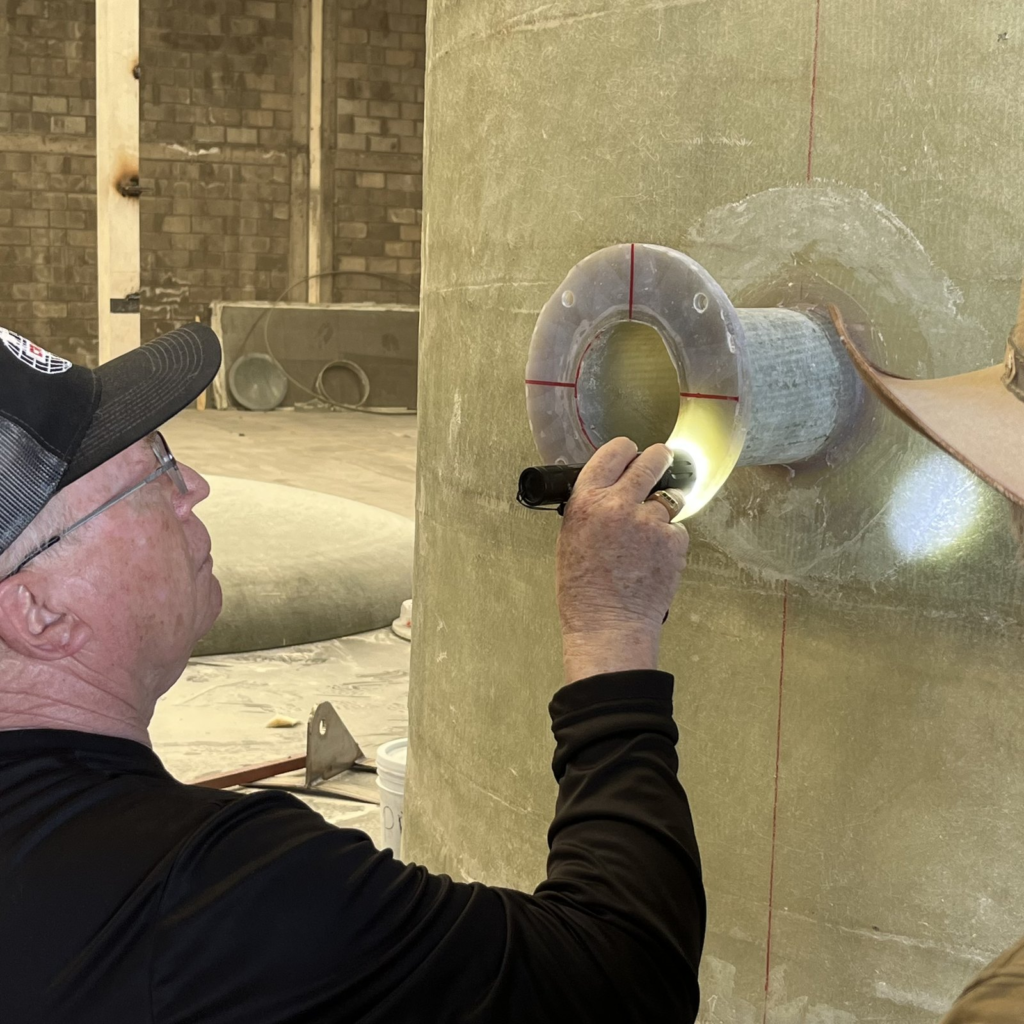
Built to the OEM’s specification, ITP and packing rules
Most acid wash vessels are bought by a process OEM as one line item in a complete elution or ADR package. The purchase order arrives with the OEM’s specification, Inspection & Test Plan, tagging and packing standards, and the documents are deliverables in their own right. We work to them:
- Inspection against the ITP, with hold and witness points for the client or a third-party inspector
- Approval and information documents scheduled inside the quoted lead time
- Fastener certificates (for example ISO 898-1 and -2) and material traceability
- Equipment tagging, packing lists and export packing for sea, road and remote-site delivery
- A priced spare-parts list with the quotation
- A clear scope split: what we supply, what the OEM free-issues for assembly, and what ships direct to site
More on our process: Quality & Inspection · Engineering & Design · Standards & Compliance
Typical schedule: about 12 to 14 weeks to ready-to-ship
| Stage | Typical duration |
|---|---|
| Design calculations (PE-stamped where required) | About 2 weeks |
| Fabrication drawings and client approval | About 2 weeks |
| Fabrication after drawing approval | 6 to 8 weeks |
| Client or third-party inspection | About 1 week |
| Packing and dispatch | About 1 week |
Two fabrication bases, one point of contact
Hermosillo, Sonora, Mexico
Our own FRP shop, a day’s drive from Arizona. Suited to mines in the southwestern United States, Nevada and northern Mexico, where road delivery and a short transit matter, and to replacement parts for vessels already in service.
China
A highly automated filament-winding partner shop that has built our acid wash columns since 2016. Suited to export projects where fabricated cost and container or break-bulk shipping from Asia give the best landed price.
Either way, the contract, engineering review, document control and inspection coordination are handled by the same Crimar team, managed from Tucson, Arizona. When we quote, we can price both routes so you can compare landed cost and delivery date side by side. See FRP Fabrication.
Acid wash track record
Selected acid wash vessels and related carbon-circuit equipment supplied by Crimar. Mine names are withheld under customer confidentiality.
| Year | Equipment | Client / site | Key data |
|---|---|---|---|
| 2016 | FRP acid wash column | FLSmidth, export gold project | 28 m³, ASME RTP-1, Derakane 411 |
| 2017 | FRP acid wash column and dilute acid tank (3 units) | FLSmidth, export gold project | 28 m³ and 36 m³, ASME RTP-1, Derakane 411 |
| 2026 | FRP acid wash vessel with FRP outlet screen and support frame | FLSmidth, gold ADR plant in South America | ≈10 t carbon batch, 1.9 m ID × ≈8.5 m, ≈22.8 m³, ASME RTP-1, full MDR. Read the case study |
| 2026 | Replacement FRP cone section for an existing carbon acid wash tank | Gold mine restart, Nevada, USA | Fabricated in Hermosillo, Mexico, with engineered design calculations |
Already running an acid wash tank? Cones take the most wear from carbon transfer. We fabricate replacement cones, nozzles and complete like-for-like vessels from your existing drawings, or from field measurements when the drawings are lost.
Acid wash and CIP tanks beyond gold
The same construction serves other acid-wash duties: clean-in-place (CIP) acid tanks for ultrafiltration and reverse-osmosis membrane plants, dilute acid day tanks, and acid regeneration and neutralization tanks in water and wastewater treatment and chemical processing. Vertical FRP tanks of this kind are covered on our FRP Tanks & Vessels page.
What to send for a fast, accurate quote
- Carbon batch size (tonnes) or working volume
- General arrangement or reference drawing, nozzle schedule and scope sheet
- Acid type and concentration, operating temperature and wash sequence
- Design code, project specification, ITP and packing specification
- Internals: which screens, spray nozzles and fasteners we supply and which are free-issued
- Site location, delivery terms (FCA, FOB or DAP) and required-on-site date
Missing some of it? Send what you have. For budgetary pricing we can work from a comparable vessel we have already built and state our assumptions on resin, corrosion barrier, laminate and design conditions.
Frequently asked questions
What is an acid wash vessel in a gold plant?
It is the tank or column in the carbon stripping (ADR) circuit where loaded activated carbon is washed with dilute hydrochloric acid, usually about 3% HCl, to remove calcium carbonate and other inorganic scale before the carbon goes to the elution column.
Why use FRP instead of stainless or rubber-lined steel?
Hydrochloric acid attacks stainless steel through chloride pitting and crevice corrosion. Rubber-lined steel depends on a lining that must be inspected and repaired. A vinyl ester FRP vessel resists dilute HCl through its full wall, weighs far less, and has its nozzles laminated in as part of the same corrosion-resistant structure.
Which resin do you use?
For ambient acid washes, a premium bisphenol-A epoxy vinyl ester such as Derakane 411. Where the acid is heated, a novolac vinyl ester such as Derakane 470. The corrosion barrier uses a synthetic surfacing veil, and the final choice follows the project specification and the resin manufacturer’s chemical-resistance guidance.
How long does it take to build an FRP acid wash vessel?
Typically about 12 to 14 weeks from purchase order to ready-to-ship: about 2 weeks of calculations, 2 weeks for drawing approval, 6 to 8 weeks of fabrication, then a week each for inspection and packing. The confirmed schedule depends on shop loading when the order is placed.
Can you supply the outlet screens and spray nozzles?
Yes. We can supply wedge-wire lateral screens (for example in Hastelloy C-276), spray nozzles, pins and fasteners, or install screens and nozzles free-issued by the OEM. Our quotation states clearly which items are in our scope.
Do you work to OEM specifications and ITPs?
Yes. Most of our acid wash vessels are built for process OEMs such as FLSmidth, to their specifications, Inspection & Test Plans, tagging and packing standards, with the required documents delivered as part of the scope.
Acid wash vessel on your next ADR package?
Send the drawings, scope sheet and specification. We will confirm what is in our scope, quote Mexico and China fabrication where both make sense, and give you a schedule that includes every document your ITP calls for.