
FRP Dampers & Expansion Joints
Crimar supplies FRP and FRP-lined isolation and control dampers, positive shut-off valves and FRP expansion joints for corrosive duct and scrubber systems, including our own expansion joint design, in service at copper smelters for more than 30 years.
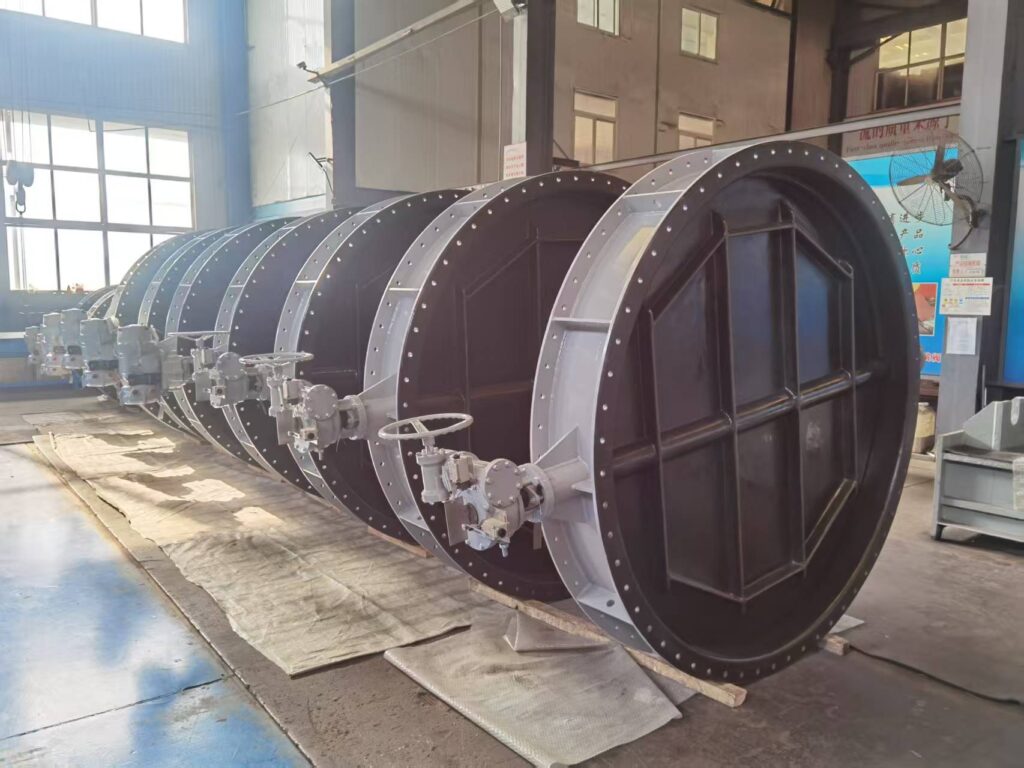
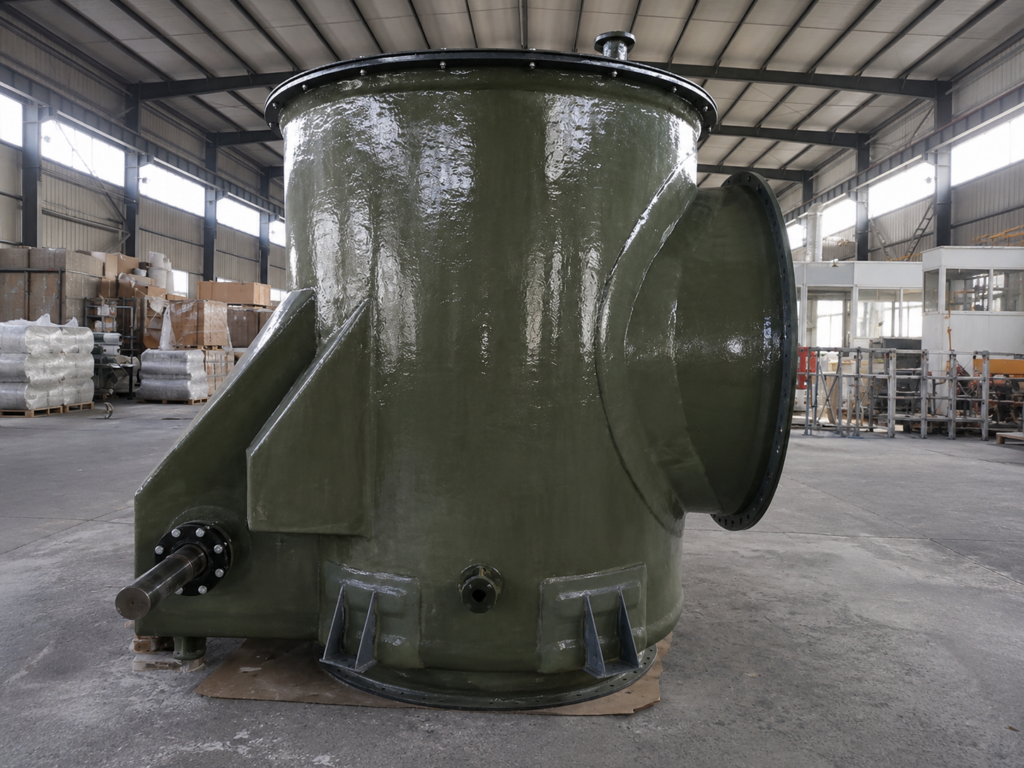
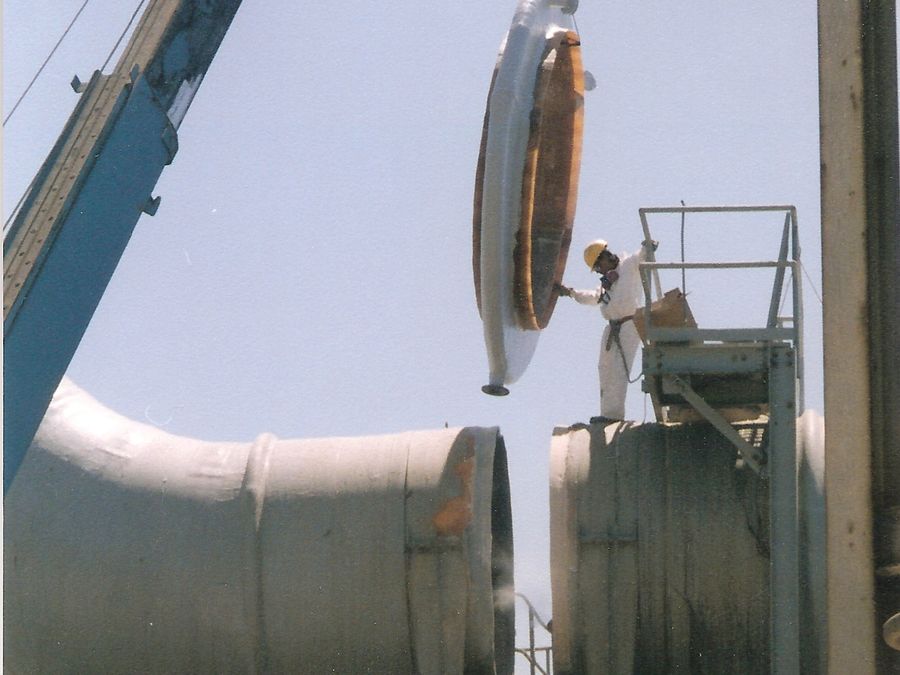
Damper and expansion joint specifications
| Parameter | Range and options |
|---|---|
| Damper types | Butterfly isolation and control dampers, positive shut-off valves; all-FRP or FRP-lined steel construction. |
| Sizes delivered | FRP-lined butterfly dampers DN1300 to DN1800; FRP dampers for smelter duct systems up to the duct diameter. |
| Construction (lined) | Carbon steel (Q235B) body, disc and retainer rings sized for pressure, vacuum and maintenance loads, lined with a vinyl ester corrosion barrier and surfacing veil; steel shaft sheathed in FRP so no bare metal is exposed to the gas. |
| Sealing | Fluoropolymer (PFA) sealing face with graphite gland packing at the shaft; leakage held to ≤1 % on the delivered DN1300–DN1800 dampers, tested on every unit. |
| Service conditions delivered | SO₂-bearing flue and exhaust gas with acidic condensate and entrained solids, up to about 80 °C (176 °F) and −3.4 kPa vacuum. |
| Operation | Self-locking worm-gear operators with handwheels; electric quarter-turn actuators with position feedback for remote isolation and modulating control. |
| Design standard | JB/T 8692 for the delivered lined butterfly dampers; duct design conditions and the client’s specification otherwise. |
| Expansion joints | Crimar’s own FRP expansion joint design, laminated into the duct system in the same resin and corrosion barrier as the duct. |
| Documentation | Seal and leakage test, dimensional and visual inspection, material certificates and Manufacturing Data Record; export crating. |
Project record
- FRP-lined butterfly dampers, DN1300–DN1800: isolation and control dampers for sulfur-bearing gas in a metallurgical gas-handling system, to 80 °C and −3.4 kPa with ≤1 % leakage; every unit seal-tested before shipment. Read the case study.
- Copper smelter duct systems in Texas, New Mexico and Arizona: FRP dampers and Crimar expansion joints in 48–120 in. off-gas duct, with field installation.
- Glencore: an FRP expansion joint for the Altonorte smelter in Chile (2016) and an isolation damper for the PASAR copper smelter in the Philippines (2019 shutdown).
- Biorem: FRP dampers for odor-control systems.
- Steel producer: FRP dampers for corrosive process gas.
Why dampers and expansion joints fail, and how we design against it
Corrosion at the seal and shaft
A damper body can be well protected and still fail at the shaft penetration or the seat, where bare metal meets wet, acidic gas. That is why the shaft of a lined damper is sheathed in FRP and the seat is a fluoropolymer face backed by graphite packing: the parts that move are the parts that need the most corrosion resistance.
All-FRP or FRP-lined steel?
All-FRP dampers are used throughout FRP duct systems, from smelter off-gas to odor control. For large diameters with vacuum, heavy discs and tight shut-off, a steel structure lined with FRP combines the stiffness and dimensional stability of steel with the chemical resistance of the laminate, at far lower cost than a solid fluoropolymer or exotic-alloy damper of the same size.
Expansion joints in FRP duct
What we need to quote a damper or expansion joint
- Duct internal diameter or width × height, flange standard and drilling, and face-to-face limits
- Gas composition, condensate chemistry, solids loading, and normal, maximum and upset temperatures
- Design pressure and vacuum, the differential pressure across a closed damper, and the required leakage class
- Isolation or control duty, manual or actuated, actuator type, power supply and feedback signals
- For expansion joints: axial and lateral movement, the anchor and support arrangement, and the duct wall and resin system
- Inspection points, documentation and packing requirements
Hot duct grows. FRP’s thermal expansion has to be absorbed by expansion joints and by a support design that lets the duct move without overstressing flanges and branches. Our FRP expansion joint is built into the duct in the same resin and corrosion barrier, so the joint does not become the weak point of the system, and it has been used on copper smelter off-gas systems for more than 30 years.
Resins and datasheets
Materials & resins
We select the corrosion barrier and structural laminate for each service — Derakane™ epoxy vinyl ester and AROPOL™ isophthalic polyester systems — matched to the chemistry, temperature and abrasion of your process. Common choices and datasheets:
Derakane 411 — general corrosion · Derakane 470HT — high temperature · Derakane 510B — fire retardant (ASTM E84 flame spread 25) · Derakane 8084 — abrasion / elastomer-modified · AROPOL 7334T — isophthalic
FRP dampers and expansion joints: frequently asked questions
What sizes of FRP-lined dampers can you supply?
We have delivered FRP-lined butterfly dampers from DN1300 to DN1800 for corrosive flue-gas service; other sizes are designed to the duct. For smaller duct, all-FRP dampers are usually the simpler choice.
What leakage can an FRP-lined damper achieve?
Our DN1300–DN1800 FRP-lined butterfly dampers were built to ≤1 % leakage with a PFA sealing face and graphite shaft packing, and each unit was seal-tested before shipment. Where tighter shut-off is needed, we also supply FRP positive shut-off valves.
What temperature and vacuum can they handle?
The delivered lined dampers were designed for SO₂-bearing gas up to about 80 °C (176 °F) and −3.4 kPa vacuum. Higher temperatures are possible with high-temperature vinyl ester laminates; the limit is set by the resin and the gas chemistry and confirmed by the resin manufacturer.
Manual or actuated?
Both. Self-locking worm-gear operators with handwheels hold the disc against differential pressure for manual isolation; electric quarter-turn actuators with position feedback allow remote isolation and modulating control from the plant control system.
Can a damper be retrofitted into existing FRP duct?
Yes, provided we have the duct’s internal diameter, flange standard and drilling, wall construction and the space available between flanges. The damper is built with flanges to match, and its corrosion barrier is chosen for the same gas as the duct it joins.
Why use an FRP expansion joint instead of a fabric or metal one?
Because it is part of the duct laminate, with the same corrosion barrier, so there is no different material to corrode or tear at the joint. Crimar’s FRP expansion joint design has been in service at several copper smelters for more than 30 years.
Request a quote for FRP Dampers & Expansion Joints
Send your drawings or service conditions and our engineers will spec it with you.