
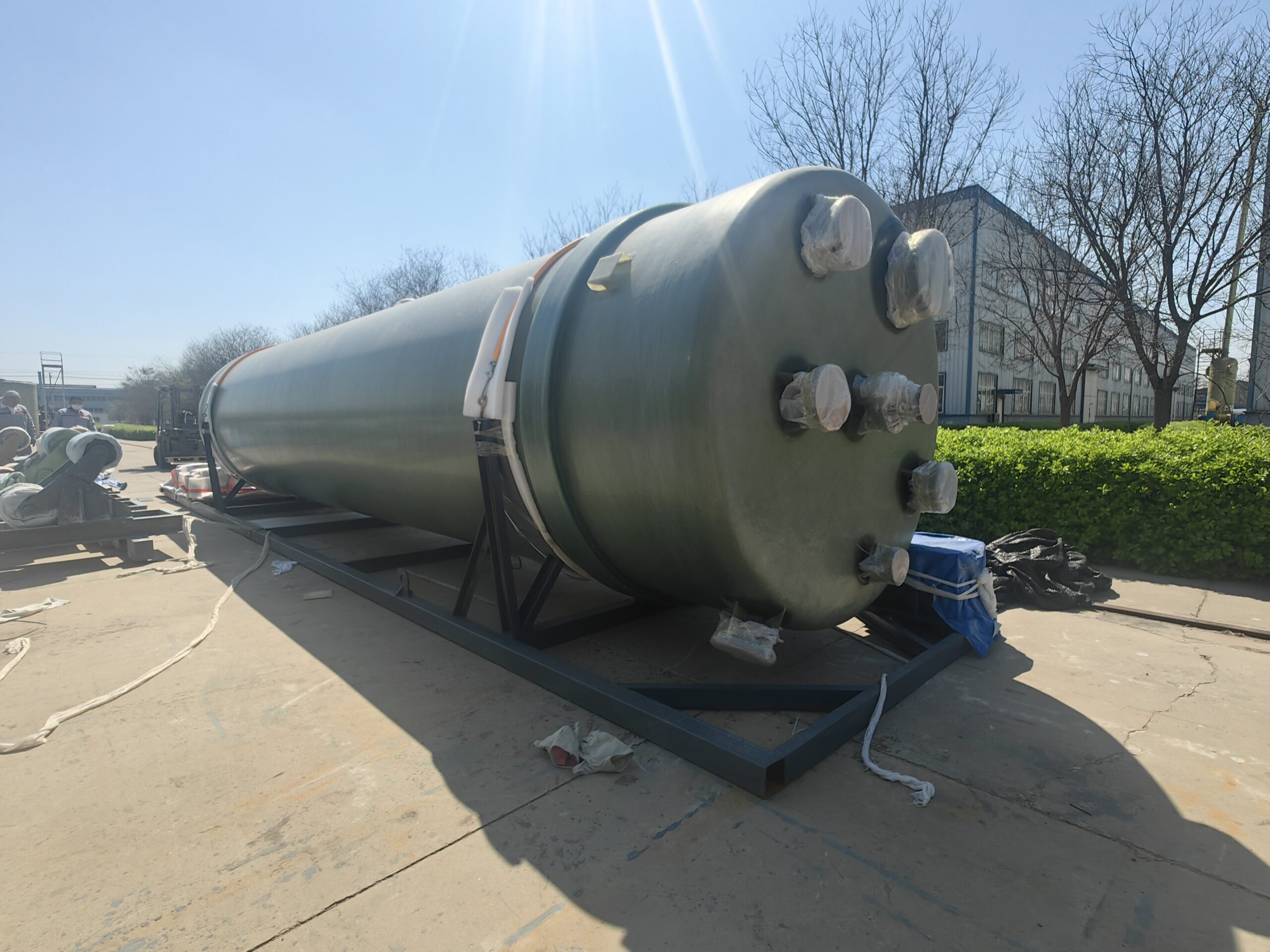
PROJECT CASE STUDY · FRP PROCESS EQUIPMENT
Custom FRP Acid-Wash Vessel for Corrosive Process Service
A purpose-built fiberglass-reinforced plastic vessel engineered for acid-wash duty, combining corrosion resistance, process connections, internal distribution components and a dedicated support frame in one coordinated package.
Project overview
For corrosive liquid service, the vessel itself is only one part of a dependable installation. This project required a custom FRP acid-wash vessel that could bring together the process envelope, connection points, internal flow-management components and support arrangement in a practical fabricated assembly.
Crimar Industrial developed the package around the operating duty rather than forcing the requirement into a standard catalog configuration. The result is a robust FRP vessel solution designed to help operators manage acidic process liquids while simplifying field coordination, handling and installation.
Designed for acid-wash duty
Acid-wash and chemical process systems place a premium on material selection, internal detailing and dependable connections. FRP is well suited to this environment because it can be engineered for corrosive service without the ongoing coating-maintenance burden associated with many metallic alternatives.
- Corrosion-resistant FRP construction for demanding acidic-process environments.
- Integrated process connections planned as part of the vessel package, not added as an afterthought.
- Wash-fluid distribution and outlet screening to support controlled flow through the process arrangement.
- Dedicated support frame for stable handling, placement and site installation.
- Custom configuration tailored to the intended process, interfaces and operating conditions.
Why FRP is the right material
In acid service, material choice affects both lifecycle performance and day-to-day operation. Fiberglass-reinforced plastic provides a corrosion-resistant composite structure that can be configured for the chemistry, temperature and mechanical demands of a specific application. Its low weight relative to many conventional materials can also simplify handling and installation while preserving the rigidity needed for industrial process equipment.
- Long-term corrosion resistance for aggressive liquid environments.
- Low-maintenance construction with no conventional external coating system to manage.
- Design flexibility for vessel geometry, nozzles, internal components and supports.
- Practical field handling through a coordinated vessel-and-frame assembly.
Technical specifications
Equipment: Custom FRP acid-wash vessel
Construction: Corrosion-resistant fiberglass-reinforced plastic composite
Configuration: Cylindrical process vessel with integrated connections, internal distribution and outlet-screening components
Support arrangement: Dedicated engineered support frame
Service: Acid-wash and related corrosive liquid process duty
Delivery approach: Complete fabricated assembly with protected loose components for handling and transit
Final configuration is developed around each process duty and site interface.
Engineered as a complete vessel package
Effective vessel execution begins before fabrication. Crimar coordinates the main vessel body with the associated process interfaces, internal components and supporting structure so the package arrives as a coherent solution. This approach reduces the risk of missed interfaces between the vessel, piping, supports and installation team.
The vessel arrangement incorporates the operating requirements of acid-wash service while keeping practical fabrication and field handling in view. Details such as connections, internal distribution elements and support points are considered together to create a package that is functional in process and manageable on site.
Manufacturing and quality assurance
Custom FRP process equipment requires disciplined workmanship at every stage. The vessel moved through defined fabrication and inspection checkpoints, from the construction of the main shell and ends through the integration of connections, internals and support components. Final checks confirmed the completed assembly before release for shipment.
Before dispatch, the fabricated vessel and associated loose components were protected and secured for transport. This focus on condition through the final stage helps preserve the finished equipment as it moves from the fabrication floor to the installation site.
Applications and value
Custom FRP acid-wash vessels are relevant wherever corrosive liquids must be contained, distributed, washed or processed in a purpose-built industrial vessel. Typical use cases include chemical processing, mineral and metals operations, water and wastewater treatment, pollution-control systems and other corrosive-service environments.
For operators, the value is not simply a corrosion-resistant tank. It is a process-ready vessel package that brings together material selection, functional internals, connection planning and practical mechanical support. That combination can reduce site coordination effort and provide a clearer path from fabrication through installation.
Frequently asked questions
What is an FRP acid-wash vessel?
It is a fiberglass-reinforced plastic vessel designed for acid-wash or other corrosive liquid service. The design can incorporate the connections, internal distribution components, screens and supports required by the intended process.
Why specify FRP instead of steel?
FRP can be engineered for corrosion resistance in acidic and chemically aggressive environments. It also provides design flexibility for custom process configurations and can reduce the maintenance burden associated with conventional coated-metal equipment.
Can the vessel be customized for an existing system?
Yes. Crimar develops custom FRP vessels around the process duty, operating conditions and site interfaces. Connection locations, internal components, support arrangements and the overall configuration can be coordinated to suit a specific installation.
What information is needed to start a vessel project?
Useful starting information includes the process liquid, operating conditions, required flow path, connection requirements, installation constraints and any applicable project standards. Crimar can then help define a practical FRP vessel solution for the service.
Planning a corrosive-service vessel?
Share your process duty, chemistry and site requirements. Our team can help develop a custom FRP vessel package that is engineered for the application.