
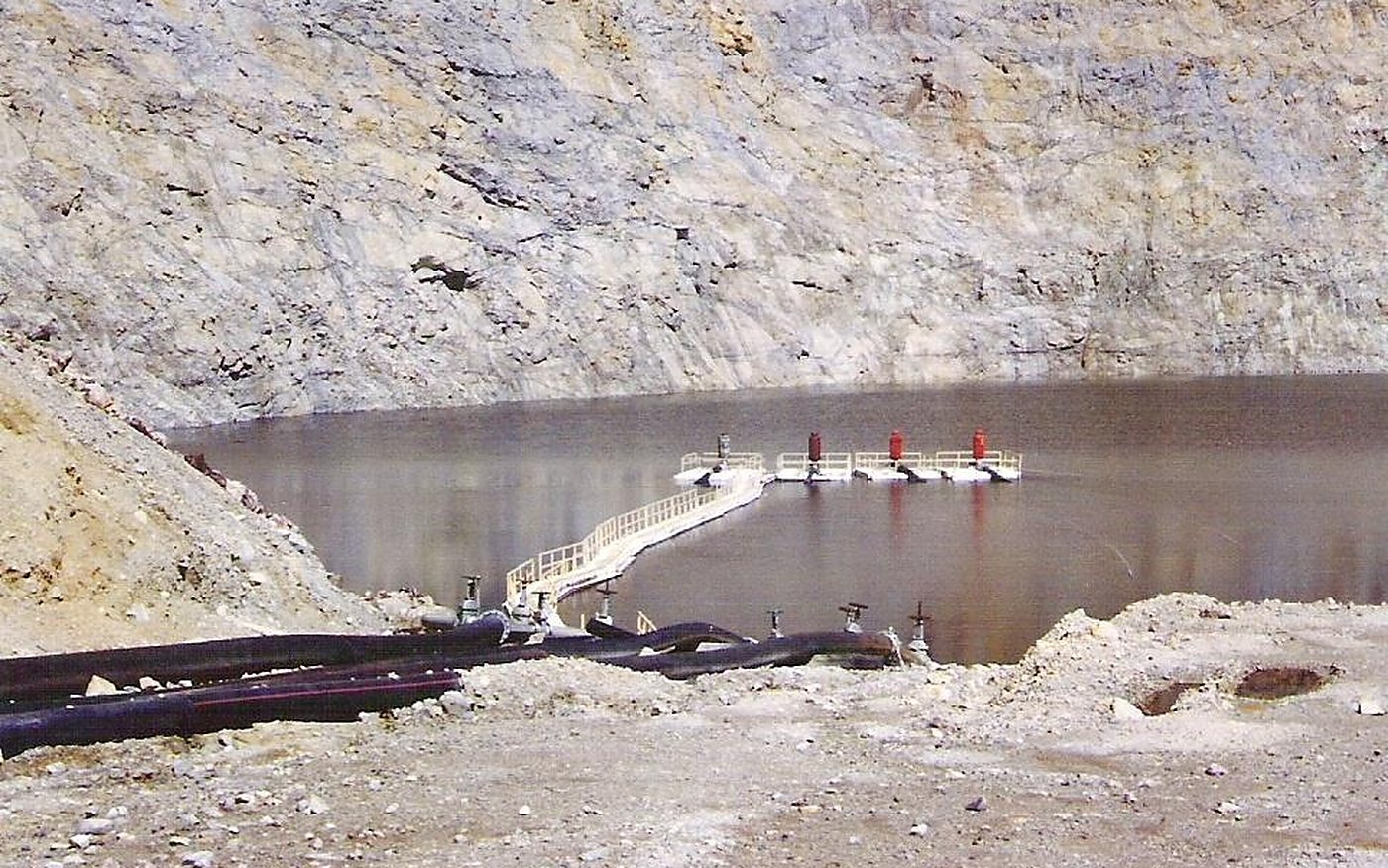
Projects · Mine Water · FRP Floating Systems
FRP Pump Barges and Floating Walkways for Mine Ponds and Reservoirs
Foam-filled fiberglass pump barges, walkways and pipe floats that put vertical pumps on the water and give operators a safe way to reach them. Crimar has built these systems for copper mines in Arizona, New Mexico and Sonora since 1997. The latest, a two-barge system with more than 250 ft of floating walkway, completed fabrication in October 2026.
1997
Year we delivered our first pump barge system
70+
FRP pump barges built for mine ponds, pits and reservoirs
240+
Floating walkway sections, plus 100+ pipe supports
20,000 lb
Pump and motor weight our barges have been built to carry
Why mines put their pumps on a barge
Leach ponds, reclaim ponds, pit lakes and process-water reservoirs do not hold a steady level. A pump fixed on the bank loses suction when the level drops and floods when it rises. A concrete intake structure solves that, but it is expensive, permanent, and hard to build in a lined pond.
A pump barge floats with the surface. The vertical pump sits through the deck at constant submergence whatever the level does, and the whole unit can be moved, pulled to shore for maintenance, or lifted out by crane when the pond is retired.
The material matters as much as the idea. Steel pontoons corrode in acidic leach solution and cannot be allowed to touch an HDPE pond liner. Our barges, walkways and pipe floats are fiberglass through and through: nothing to rust, nothing sharp against the liner, and light enough to truck to a remote site and launch with a mobile crane.
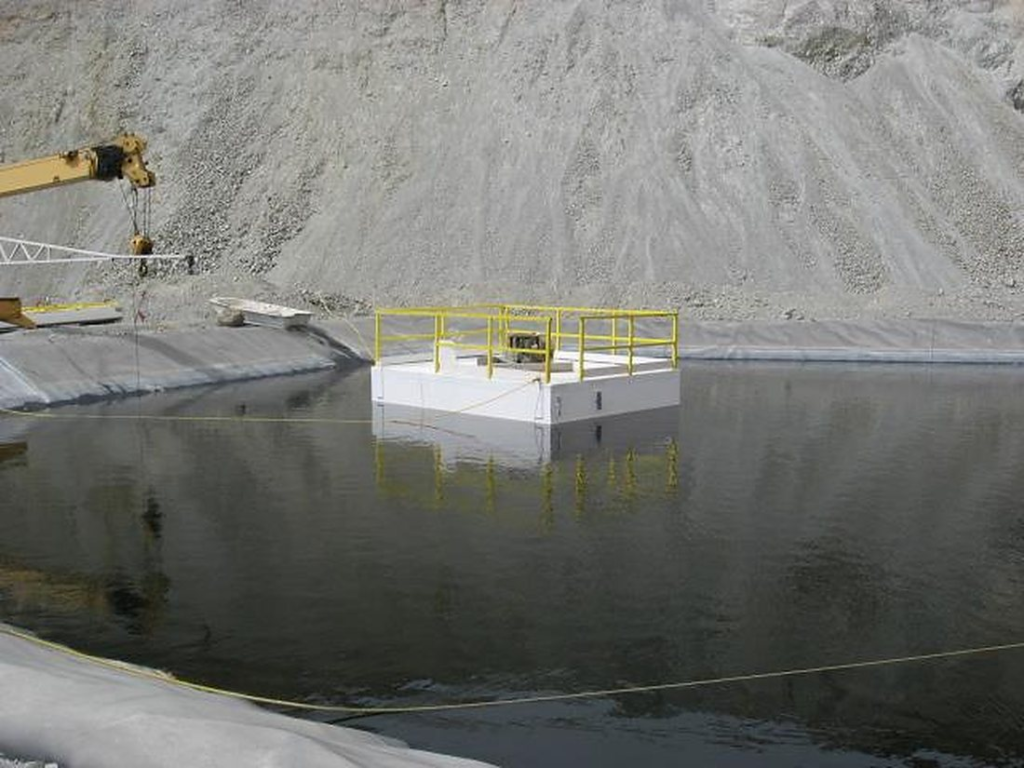
What goes into a Crimar pump barge
- It will not sink. The hull is filled with closed-cell polyurethane foam, so it stays afloat even if the fiberglass skin is damaged.
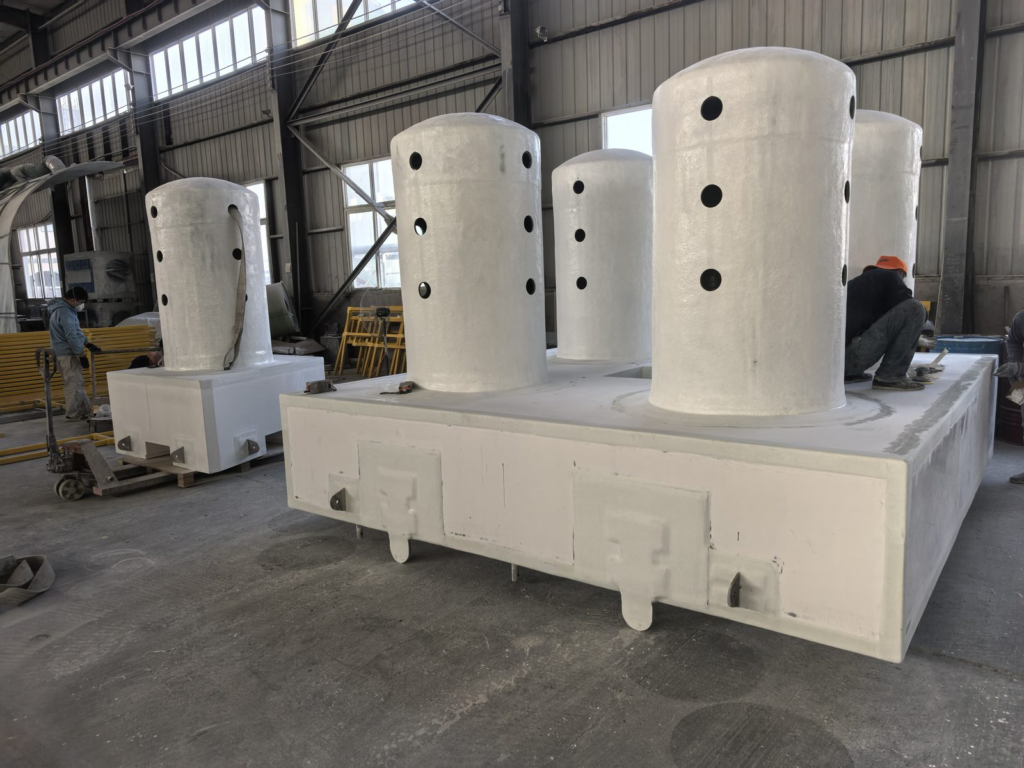
- It stays level under a tall pump. Ballast columns hang below the hull and keep the center of gravity under the waterline, with a vertical pump and motor standing on the deck.
- It is sized to your pump. Buoyancy, freeboard and deck layout are calculated from the certified pump and motor weights, the discharge piping and the cable loads.
- It suits the liquid. Isophthalic polyester resin for process and reclaim water; vinyl ester for acidic leach solutions. The exterior resists ultraviolet light.
- It protects the liner. Hull, columns and floats are all FRP, so nothing metallic can contact an HDPE pond liner in operation or during maintenance.
- It is safe to work on. Non-skid deck, OSHA-compliant fiberglass handrail around the perimeter, and clear access to the pump, motor and instruments.
- It can come ashore. Walkway sections unpin so the barge and its discharge line can be pulled to the bank, and lifting points let a crane take the barge out.
More on how we build in fiberglass: FRP Fabrication · Engineering & Design
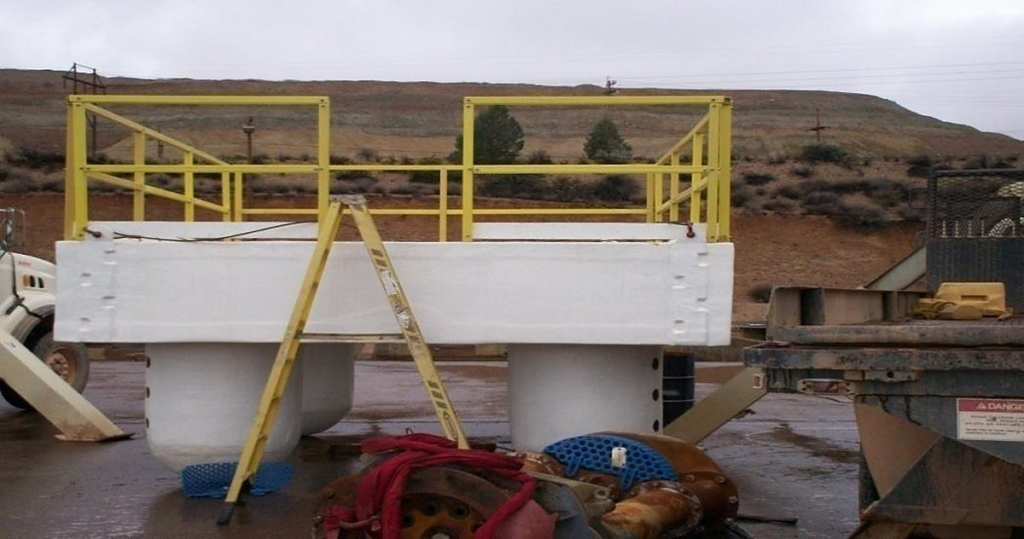
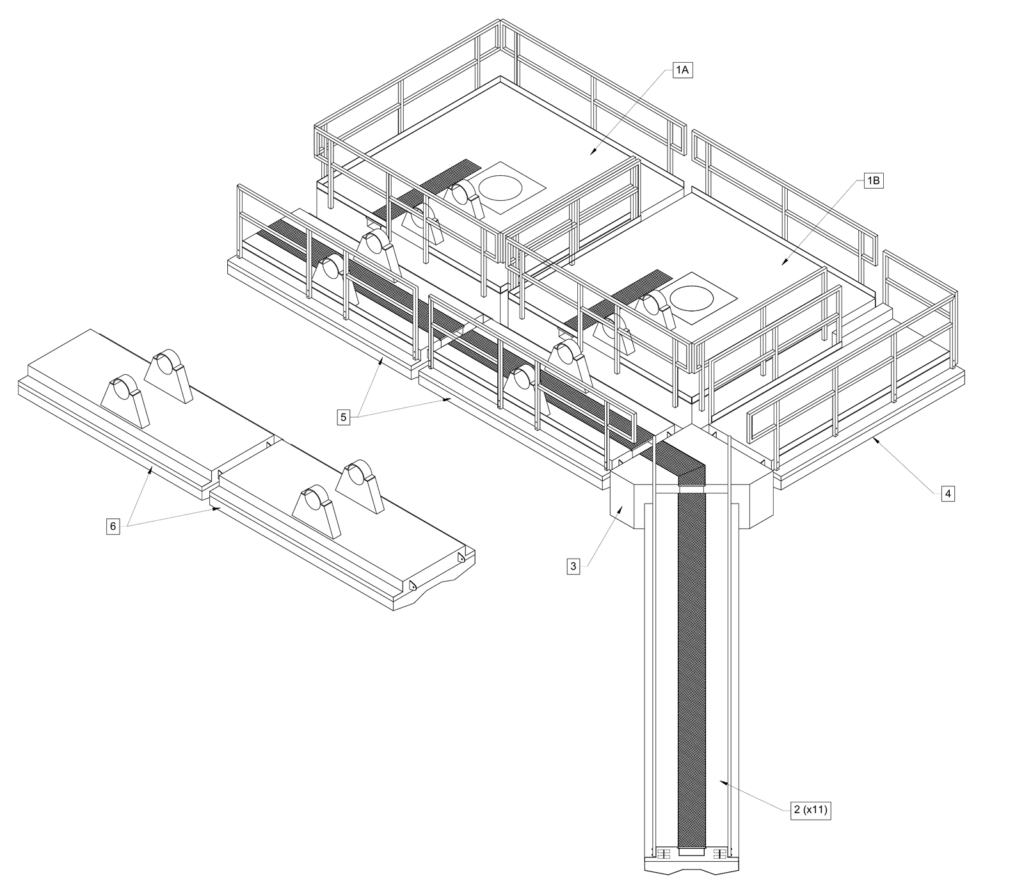
A complete floating system, not just a barge
A pump on the water needs a way to get people, power and pipe out to it. We supply the whole floating package as matched parts. The numbers below refer to the drawing.
- Pump barges (1A, 1B). One per pump, with deck opening, ballast columns and perimeter handrail.
- Floating walkway sections (2). 20 ft foam-filled sections pinned end to end from the shore, with handrail and a channel for power and instrument cables.
- Connection float (3). Turns the walkway toward the barges.
- Lateral access walkway (4). Lets operators step across to each barge.
- Service walkways (5). 12 ft sections carrying the cable tray, grating and the first pipe supports.
- Pipe floats (6). Carry the discharge line on saddle supports so its weight never hangs on the pump nozzle.
Case study · 2026
A two-barge system for a lined process-water reservoir in Arizona
A large copper mine in Arizona was building a new HDPE-lined reservoir to store process water and needed vertical turbine pumps on the water to send it back to the plant. The owner’s specification asked for a floating package that would be stable in desert storms, keep all metal off the liner, give maintenance crews a railed route from the bank to both pumps, and let the barges and their discharge lines be pulled ashore when needed.
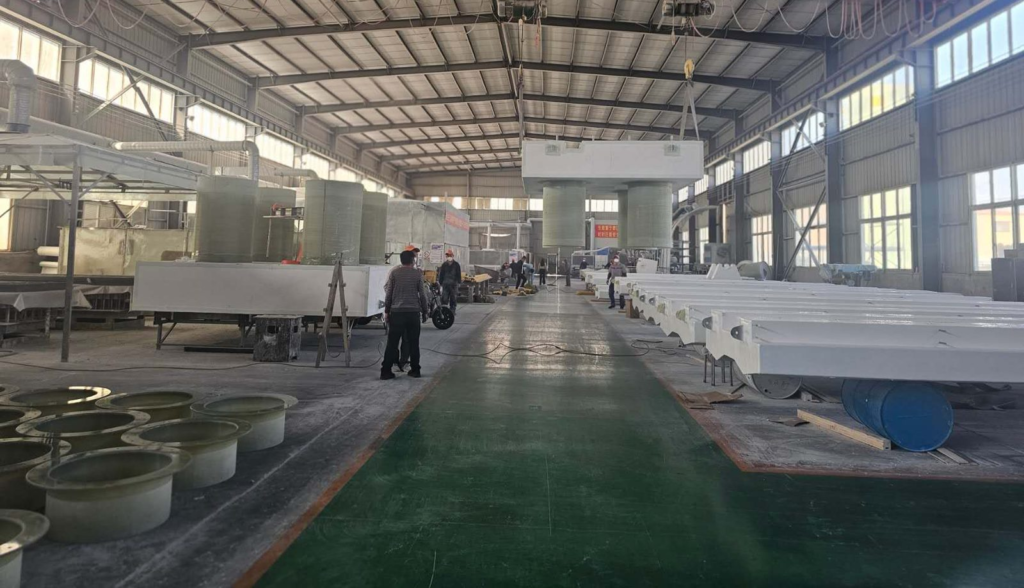
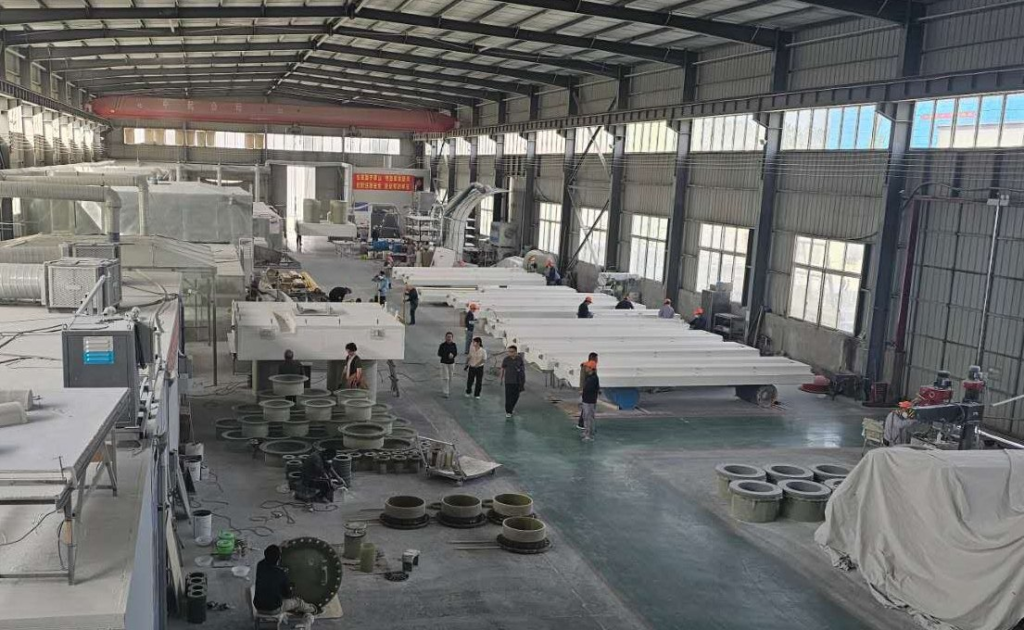
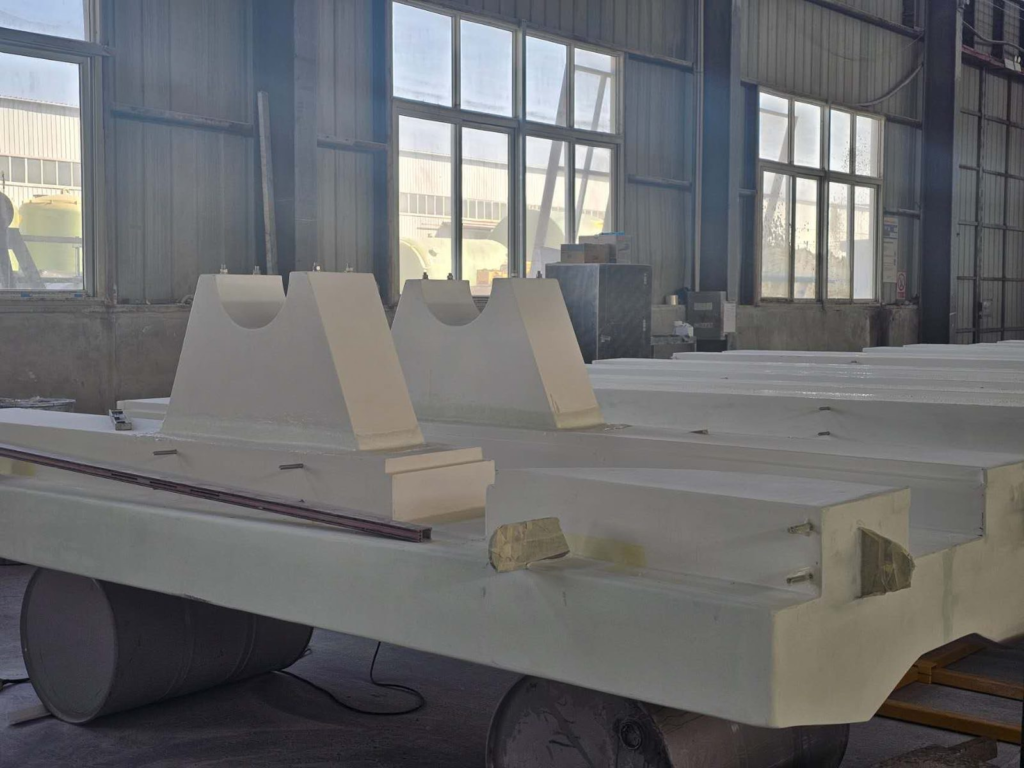
We designed the system from the owner’s general arrangement and the certified pump drawings, reviewed it in regular meetings with the owner’s engineer, and built it at Crimar’s China fabrication shop, which had the capacity and equipment to meet the schedule. Crimar’s president was on the shop floor at the start to check molds and production, and again at the end for final inspection and fit-up before packing.
| Site | Copper mine, Arizona, USA: new HDPE-lined process-water reservoir |
| Pump barges | 2 × FRP barges, 12 ft × 12 ft × 3 ft, each with four 36 in × 60 in ballast columns and perimeter handrail |
| Floating walkway | 11 × 20 ft sections with handrail and cable channel, 2 × 12 ft service sections with cable tray, grating and pipe supports, 1 × 12 ft lateral access walkway and 1 connection float: more than 250 ft in all |
| Pipe floats | 2 × 12 ft floats, each with two saddle supports for the discharge line |
| Construction | Isophthalic polyester FRP, polyurethane foam-filled, non-skid decks, yellow FRP handrail, stainless steel connection lugs |
| Schedule | About ten weeks from purchase order to fabrication complete |
| Status, October 2026 | Fabrication complete; final quality documents and shipment in preparation |
Pump barge track record since 1997
Our first system went to the Cananea copper mine in Sonora in July 1997: eight pump barges, sixteen walkways, eight pipe supports and a cable distribution float. Repeat orders followed from the same ponds and from mines across the US Southwest. By 2014 the log stood at 72 pump barges, 229 walkway sections, 100 pipe supports and 5 cable distribution floats.
| Operator and site | Location | Years | Pump barges | Also supplied |
|---|---|---|---|---|
| Mexicana de Cananea (Grupo México) | Sonora, Mexico | 1997–2005 | 42 | Walkways, pipe supports, cable distribution floats |
| Phelps Dodge, later Freeport-McMoRan: Chino | New Mexico, USA | 1998–2009 | 13 | Walkways, pipe supports |
| Phelps Dodge, later Freeport-McMoRan: Tyrone | New Mexico, USA | 2004–2013 | 5 | Walkways, pipe supports |
| Freeport-McMoRan: Safford, Miami, Sierrita | Arizona, USA | 2011–2013 | 6 | Walkways, pipe supports |
| Asarco: Ray, Silver Bell | Arizona, USA | 2004–2014 | 3 | Walkways, pipe supports |
| Molycorp | USA | 2005 | 2 | |
| Jordan Magnesium (through AMEC) | Jordan | 2001 | 1 | Walkways |
| Copper mine, lined process-water reservoir | Arizona, USA | 2026 | 2 | 14 walkway sections, 2 pipe floats, connection float |
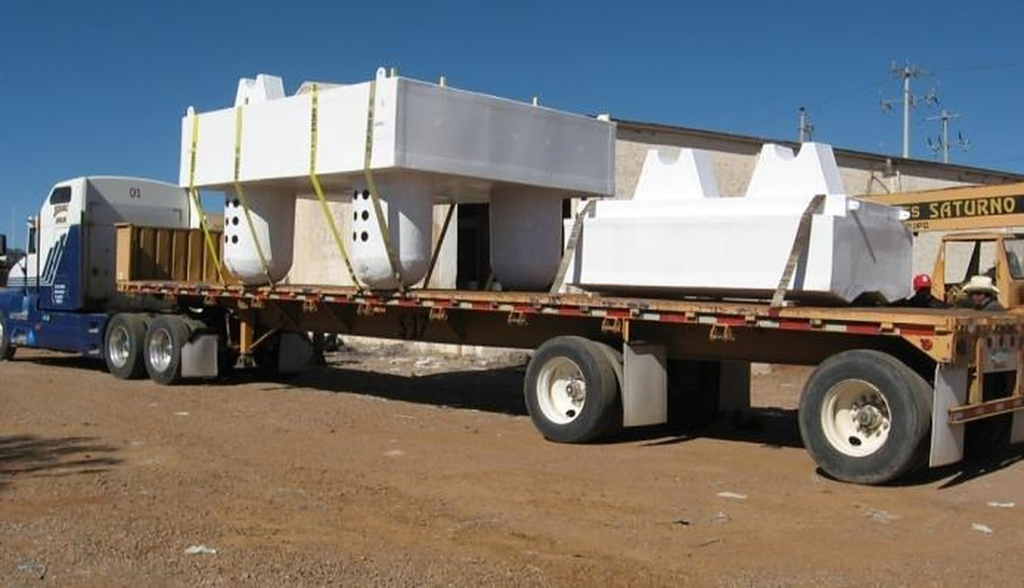
Adding to a pond you already run? Many of these orders were extensions: more walkway as a pond grew, extra pipe supports for a new line, or a replacement barge for a larger pump. We build to match the units you have, from our drawings or yours.
See also FRP for SX-EW plants and mining and mineral processing.
How a pump barge project runs
- Sizing. From the pump and motor weights, pipe and cable loads and the pond conditions, we size the hull, ballast and freeboard.
- Drawings for approval. General arrangement and detail drawings go to you and your engineer for review, and we hold review meetings until they are approved.
- Fabrication. Hulls, floats and columns are molded in FRP and foam-filled; handrail, grating and cable channels are built alongside.
- Shop fit-up and inspection. Sections are laid out and pinned together in the shop to prove the fit, then inspected and documented. See Quality & Inspection.
- Packing and delivery. Units are packed for sea and road and ship on standard flatbeds; on site they are launched by crane and pinned together on the water.
What to send for a quote
- Number of pumps, with pump and motor weights and outline drawings
- Discharge pipe size and material, and how far it runs across the water
- The liquid: process water, reclaim, leach solution or raffinate, with pH and temperature
- Whether the pond is lined, its depth and its operating level range
- Distance from the bank to the pumps, which sets the walkway length
- Power and instrument cable weights, and site wind conditions
- Site standards for handrail and access, and the date you need it on site
If you only have a sketch and a pump model, send that. We can propose an arrangement from a comparable system we have already built.
Frequently asked questions
What is an FRP pump barge?
It is a foam-filled fiberglass float that carries a vertical pump and its motor on a pond, pit lake or reservoir. The pump hangs through an opening in the deck, so it stays at the same depth as the water level rises and falls.
How much weight can a pump barge carry?
Each barge is sized for its pump. We have built barges for pump and motor sets of up to 20,000 lb, and the hull and ballast are calculated from the certified weights for your equipment.
Will the barge sink if the hull is damaged?
No. The hull is filled with closed-cell polyurethane foam, so it keeps its buoyancy even if the fiberglass skin is punctured.
Can FRP pump barges be used in HDPE-lined ponds?
Yes. The hull, ballast columns, walkways and pipe floats are all fiberglass, so no metal part can contact the liner, in service or when the barge is pulled to the bank.
Which liquids can the barges float in?
Process water, tailings reclaim water, and acidic copper leach solutions such as PLS and raffinate. We select the resin for the chemistry: isophthalic polyester for water service and vinyl ester for acid service.
How do operators reach the pumps?
By a floating FRP walkway pinned in sections from the bank to the barges, with handrail on both sides and a channel for power and instrument cables. The sections unpin when the barge has to come ashore.
How long does a pump barge system take to build?
Our 2026 two-barge system, with more than 250 ft of walkway, took about ten weeks from purchase order to fabrication complete. The schedule depends mainly on how quickly drawings are approved.
Planning pumps on a pond or reservoir?
Send the pump data and a sketch of the pond. We will size the barges, lay out the walkway and pipe floats, and come back with drawings, a price and a delivery date.