
Arizona has become one of the most important semiconductor manufacturing centers in the United States. The state has attracted major investments across wafer fabrication, advanced packaging, semiconductor equipment, materials, research and the infrastructure that supports these operations.
Public attention naturally focuses on cleanrooms and chip-making tools. Behind those environments, however, a semiconductor facility depends on a far larger network of chemical storage, exhaust handling, emissions control, wastewater treatment and utility systems. Many of those systems operate in chemically aggressive conditions, creating potential applications for properly engineered fiberglass-reinforced plastic (FRP) equipment.
FRP is not an automatic substitute for metal in every semiconductor application. Material compatibility depends on the chemical, concentration, temperature, gas composition, pressure or vacuum conditions, cleanliness requirements and applicable facility standards. Where resin selection and laminate construction are matched to the service, FRP can be a practical option for selected corrosion-resistant facility systems.
Corrosion is a facility-wide engineering challenge
Semiconductor manufacturing uses a range of chemicals for wafer cleaning, etching, deposition and related processes. Acidic and chemically aggressive streams can appear in exhaust, wastewater, neutralization and support systems. The practical challenge is not simply containing a chemical. It is specifying equipment that accounts for chemical resistance, operating conditions, structural loads, inspection access, fire-performance requirements and the interfaces between equipment packages.
That is why each opportunity needs project-specific review. A design that performs well in mining, chemical processing or wastewater treatment should not be assumed suitable for a semiconductor facility without checking the actual duty and specifications.
Where FRP may fit in semiconductor facilities
1. Acid exhaust ductwork
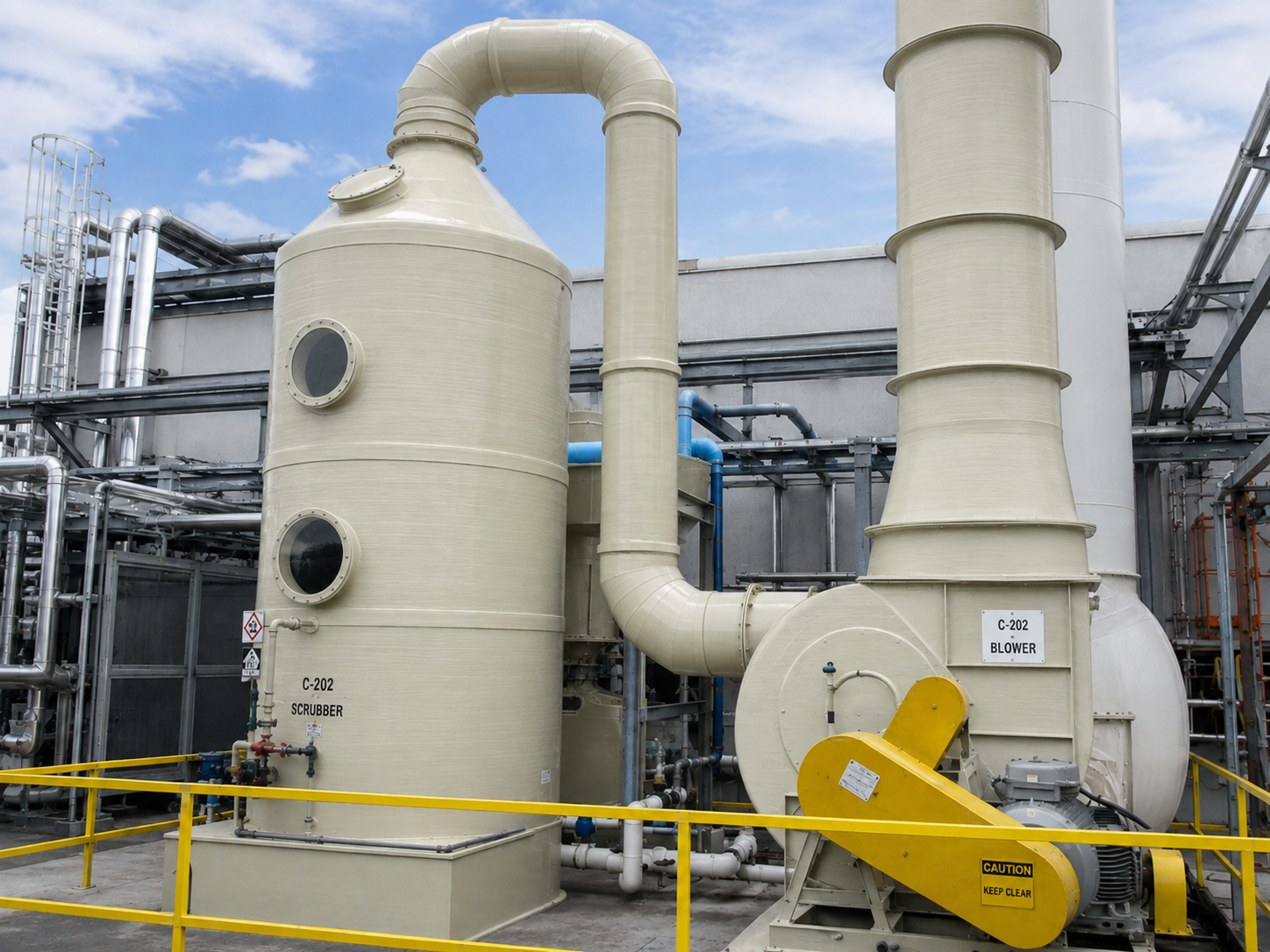
Acid exhaust systems collect and transport corrosive fumes from process areas to treatment equipment. Potential FRP components include straight duct sections, elbows, tees, reducers, transitions, flanges, stacks, dampers, expansion joints and scrubber inlet or outlet ductwork.
Unlike ordinary HVAC ductwork, acid exhaust systems must be evaluated for chemical exposure, temperature, pressure or vacuum, fire performance, support spacing and structural loading. Crimar fabricates custom FRP ductwork, piping and fittings for corrosive industrial service, including the transitions and interfaces that connect a larger exhaust system.
2. Wet scrubbers and absorption towers
Wet scrubbers treat contaminated exhaust by bringing the gas into contact with a scrubbing liquid. Depending on the process conditions, an FRP scrubber package may include packed towers, spray towers, mist-eliminator sections, recirculation tanks, spray piping, nozzles, access ports and interconnecting ductwork.
Crimar FRP scrubbers and towers are custom-fabricated around gas flow, inlet loading, chemistry and required removal performance. The final emissions-control system must still be designed or approved by the responsible process engineer: scrubber construction, internals, recirculation chemistry and operating conditions need to work together as one system.
3. Chemical storage and neutralization tanks
Semiconductor facilities can require tanks for chemical storage, wastewater collection, neutralization, recirculation and other support processes. Potential applications include chemical storage tanks, neutralization tanks, day tanks, mix tanks, scrubber recirculation tanks, wastewater collection vessels, secondary-containment components and custom process vessels.
Custom FRP tanks and process vessels can be engineered around the chemical environment, operating temperature, mechanical requirements and site constraints. When transportation limits make a completed vessel impractical, large equipment can be planned in transportable sections or assembled at the project site.
4. Corrosion-resistant piping and fittings
FRP piping may be considered for selected corrosive utility, wastewater, scrubber-recirculation and chemical-transfer services. A complete system can include straight pipe, elbows, tees, reducers, flanges, laterals, spools and custom fittings.
Each piping system requires detailed review of internal pressure, vacuum, surge conditions, support spacing, thermal movement, joint design and chemical compatibility. FRP should not be assumed suitable for ultra-high-purity chemical distribution or other contamination-sensitive process applications without engineering review and project-specific qualification.
5. Grating, platforms and access structures
Corrosive areas around scrubbers, wastewater systems and chemical equipment may also benefit from nonmetallic structures such as FRP grating, platforms, walkways, handrails, ladders, cable-support components and equipment covers. In the right environment, these components can reduce corrosion-related maintenance where steel would otherwise need repeated coating, repair or replacement.
Loading, fire and smoke performance, conductivity and cleanroom requirements must be checked before any structural FRP product is specified.
Why engineers consider FRP
FRP is an engineered composite, not a commodity substitute for steel. Its performance depends on the full laminate design, the resin-rich corrosion barrier, the structural laminate and the details of how the equipment is supported and connected.
- Corrosion-resistant construction: Resin systems and corrosion barriers can be selected for a defined chemical service.
- Custom fabrication: Hand lay-up and filament-winding methods support custom diameters, lengths and geometries for retrofit and utility systems that do not fit catalog dimensions.
- Lower weight: FRP components are generally lighter than comparable steel components, which may simplify lifting, transport and installation when the final support system is properly engineered.
- Shop or field fabrication: Large tanks and duct systems can be produced in transportable sections or assembled at site when necessary.
- Inspection and documentation: Projects can include dimensional checks, thickness verification, visual inspection, Barcol hardness testing and documentation to suit the specification.
Learn more about Crimar’s approach to quality and inspection, including the inspection activities that support custom composite equipment.
What “semiconductor-grade FRP” really means
“Semiconductor-grade FRP” should not be treated as a generic marketing label. A semiconductor project may impose requirements for flame spread and smoke development, cleanroom contamination control, surface finish, static conductivity, exhaust-system standards, resin traceability, additive restrictions, seismic design, factory acceptance testing or site-specific material approvals.
For this reason, Crimar reviews the customer’s chemistry, temperature, mechanical conditions, drawings, specifications and quality requirements before recommending a construction approach. The goal is to determine whether FRP is technically appropriate for the specific service, not to apply one laminate design to every facility system.
Information needed for an FRP equipment quotation
A useful starting package for an FRP tank, scrubber, ductwork or piping inquiry includes:
- Equipment type and intended function
- Process chemical or gas composition and concentration
- Normal and maximum operating temperature
- Gas-flow rate for exhaust or scrubber systems
- Operating pressure or vacuum
- Required dimensions, connection sizes and design loads
- Indoor or outdoor installation conditions
- Fire, smoke, resin and laminate requirements
- Applicable design and fabrication standards
- Drawings, technical specifications, inspection requirements and delivery date
Where a complete specification is not yet available, Crimar can review preliminary service conditions and identify the additional information needed to prepare a quotation. For supporting technical information, visit our Resources and Material Datasheets.
Supporting the infrastructure behind advanced manufacturing
Arizona’s semiconductor expansion creates opportunities across a broad industrial supply chain. Not every supplier will make wafer-processing equipment. Many of the critical needs are in the supporting infrastructure that allows a facility to operate safely and reliably: exhaust handling, chemical storage, emissions control, wastewater treatment and corrosion-resistant utility systems.
Crimar Industrial manufactures custom FRP tanks, process vessels, ductwork, piping, scrubbers, towers, dampers, expansion joints, covers and grating for demanding industrial environments. We work with engineering firms, equipment integrators, contractors and industrial end users to review the duty and build equipment around the project requirements.
Planning a corrosion-resistant facility system?
Send us the process duty, chemistry, dimensions and applicable specifications. Our team will review the requirement and determine whether FRP is technically appropriate for the application.