
A solid-bottom FRP cable tray is only as good as the checks it passes before it ships. This article walks through the release inspection on a recent Crimar order of about 1,100 m of green, trough-type FRP cable tray, so an engineer or buyer can see what is measured, to what tolerance, and what is not covered.
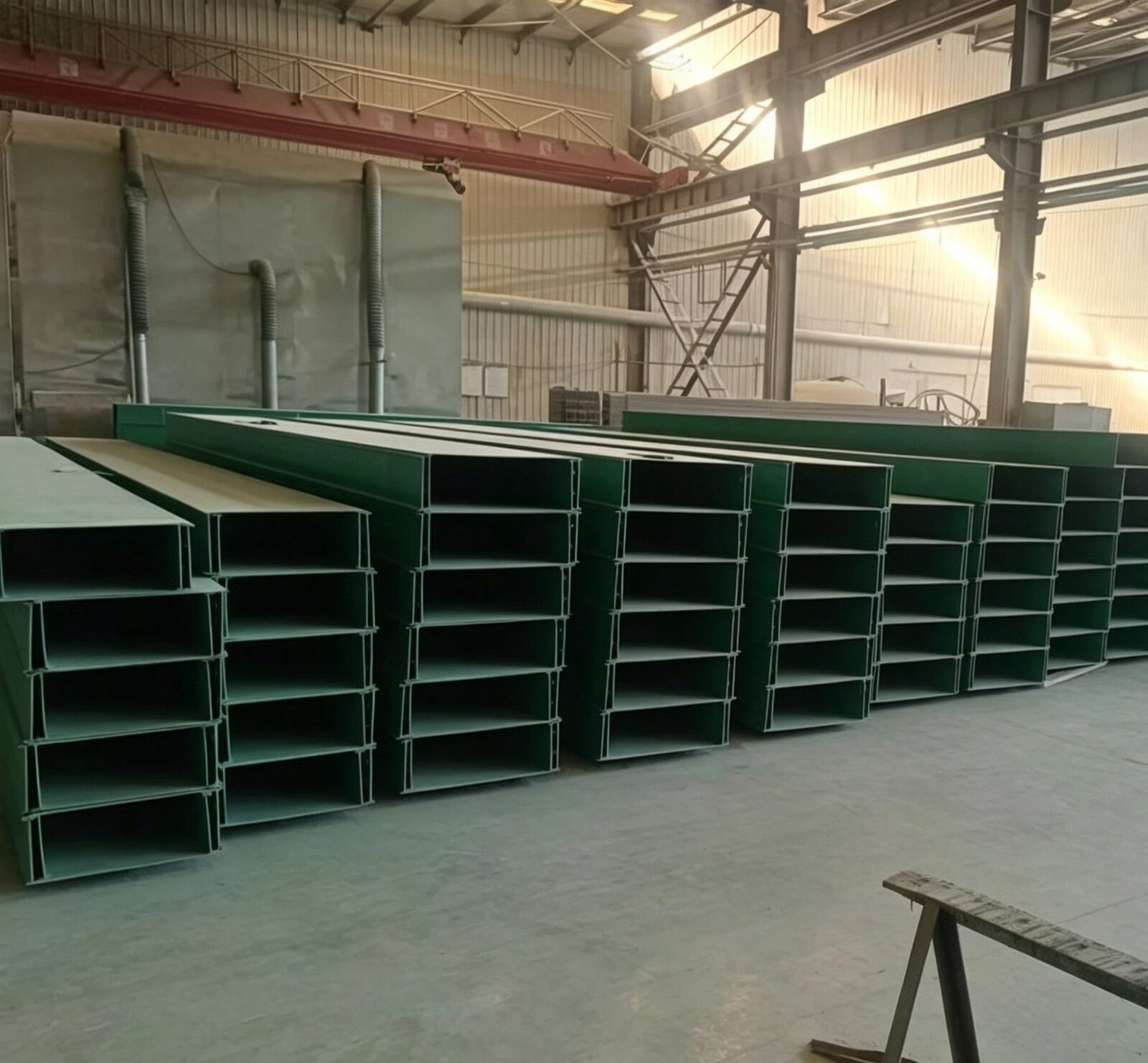
What trough-type FRP cable tray is
Trough-type tray has a solid bottom and two side walls, so cables are supported along their full width and shielded from falling debris and spray from below. It differs from ladder-type tray (rungs between two rails) and from open grating. Crimar’s order was the solid-bottom channel form, made in fiberglass-reinforced plastic with a fire-retardant isophthalic polyester resin, finished green.
FRP does not rust, so it is a common choice where steel tray corrodes: wet areas, chemical and mineral-processing plants, and coastal or washdown environments.
The order in brief
| Item | Detail |
|---|---|
| Product | Trough-type straight cable tray, green FRP |
| Straight length | 6,000 mm |
| Sizes (width × height) | 600 × 200 mm and 500 × 200 mm |
| Total straight tray | About 1,100 m |
| Resin | Fire-retardant isophthalic polyester |
| Release inspection | 29 October 2026, all items qualified |
What the release inspection covered
The inspection was a factory release test on the straight sections. A stamped and signed qualification certificate was issued for each size. The report covers three groups of checks.
1. Visual inspection
Each piece is examined for a flat, smooth surface and uniform color. The report records no wrinkling, cracks, particles, resin run-off, resin peeling, exposed fibers or sticky surface, and no delamination. Resin content is uniform and the cure is stable. Air bubbles are limited to a total of 100 mm² per piece, with no single bubble larger than 15 mm².
2. Thickness
Wall thickness must be at least the specified minimum. It is a pass-or-fail check on every size.
3. Dimensional accuracy
| Dimension | Tolerance |
|---|---|
| Straight length up to 2,000 mm | ±2.0 mm |
| Straight length over 2,000 mm | ±4.0 mm |
| Other dimensions | GB/T 1804-2000, grade V |
| Flatness | 5.0 mm per m² or less |
GB/T 1804-2000 is the Chinese standard for general tolerances on dimensions without individual tolerance notes. It governs dimensions only. It is not a load or material standard.
What a release inspection does not tell you
A release test confirms the pieces match the order. It does not replace project engineering. Span, support spacing, cable load, temperature and the chemical environment are decided from the project’s own requirements, so state them when you request a quote. This report also covers straight sections only; it does not include fittings such as bends.
FAQ
Is trough-type or ladder-type tray better?
Trough-type suits runs where cables need full support and protection from debris or drips from below; ladder-type suits runs where ventilation and easy cable access matter more. The choice follows the cable type and the environment.
Why choose FRP over steel tray?
FRP is the better choice where corrosion would shorten the life of steel: wet, chemical or coastal service. FRP does not rust. Load and span still need to be checked against the project’s requirements.
What size does trough-type FRP tray come in?
Crimar’s recent order was 600 × 200 mm and 500 × 200 mm in 6,000 mm lengths. For other widths and heights, send your requirements with the inquiry.
What tolerances apply to straight lengths?
The release test on this order allowed ±2.0 mm on lengths up to 2,000 mm and ±4.0 mm above 2,000 mm, with flatness of 5.0 mm per m² or less.
How many air bubbles are acceptable in the laminate?
On this order, up to 100 mm² in total per piece and no single bubble above 15 mm².
What should I send with a cable tray inquiry?
Send the tray width and height, run lengths, fittings needed, installation environment, cable load, and delivery location. Drawings help.