Gold has stopped behaving like just another commodity. At the FT Metals and Mining Summit in London this week, the debate over gold’s place in the world economy kept returning to who is buying it. After four years of central bank stockpiling, Endeavour Mining chief executive Ian Cockerill pointed to a structural shift in demand from retail investors to central banks, and saw it as a foundation for sustaining the US$4,000-per-ounce level gold has reached over the past two years, Mining Magazine reported.
A price at that level changes the arithmetic on projects that have sat idle for years. In Nevada, Mackay Gold & Silver has agreed to acquire Comstock Inc.’s mining assets, including a fully permitted heap leach and Merrill-Crowe facility at American Flats rated at about 4,500 tonnes per day. The plant operated from 2012 to 2016 and has been on care and maintenance since. At the other end of the scale, the summit heard that formalising artisanal and small-scale gold mining (ASGM) has to be an industry priority. The World Gold Council’s formalisation vision includes centralized processing plants that improve recovery rates and supply-chain transparency, as part of an effort that also targets the mercury pollution long associated with the sector.
Restarts, expansions and new centralized plants all lead to the same place: process equipment. Much of a gold plant runs in alkaline conditions that carbon steel handles well. A few circuits, though, are among the most corrosive duties on any mine site, and that is where corrosion-resistant equipment made from fiberglass-reinforced plastic (FRP) earns its place.
What US$4,000 gold means for processing plants
- Idle plants coming back. Heap leach, Merrill-Crowe and carbon-in-leach (CIL) plants on care and maintenance become candidates for restart. Equipment that has sat for years needs inspection, and linings, coatings and seals in acid service are often the first items to fail it.
- Expansions at operating mines. More ore through the leach circuit means more loaded carbon to wash and strip, more solution to pump and more reagent to store.
- New, smaller and more remote plants. Centralized plants serving formalised small-scale miners tend to be modular and far from heavy-lift infrastructure, so equipment weight and transport limits matter.
- Compressed schedules. When the price window is open, owners want production sooner, which puts pressure on long-lead fabricated equipment.
Where corrosion concentrates in a gold plant
In a cyanide leach circuit, lime holds the slurry at high pH, typically around 10 to 11, so that cyanide stays in solution rather than forming hydrogen cyanide gas. At that pH, carbon steel leach tanks are standard practice. The corrosion problems sit around the leach circuit: wherever acid is used to clean carbon, refine product or treat water, and wherever solution has to be pumped out of lined ponds.
| Plant area | Corrosive duty | Where FRP fits |
|---|---|---|
| Carbon acid wash (ADR plant) | Dilute hydrochloric acid, abrasive carbon transfers, HCl vapor at the vent | Acid wash vessels and columns, vent ducting |
| Refinery and gold room | Acids used to clean or treat cathodes, sludge and precipitate; acid fumes | Fume ductwork, wet scrubbers, process tanks |
| Reagent storage | Hydrochloric acid, sulfuric acid, caustic | Chemical storage and day tanks |
| Heap leach and process ponds | Leach solution and process water; HDPE liners that must not be damaged | Pump barges, floating walkways and pipe floats |
| Water treatment and neutralization | Acidic, saline or metal-bearing water | Neutralization tanks, clarifier lamella packs, covers |
| Wet process areas | Spills, splash and humidity around pumps, launders and drives | Covers, grating and guards |
Carbon acid wash: the clearest case for FRP
In carbon-in-leach and carbon-in-pulp plants, activated carbon picks up calcium carbonate, magnesium salts and other scale along with the gold. Left in place, that scale blocks the carbon’s pores, lowers stripping efficiency in the elution column and reduces the carbon’s activity when it returns to the leach tanks. Before each batch is stripped, it is cleaned in an acid wash vessel with dilute hydrochloric acid, usually about 3% HCl, then rinsed and transferred to the elution column.
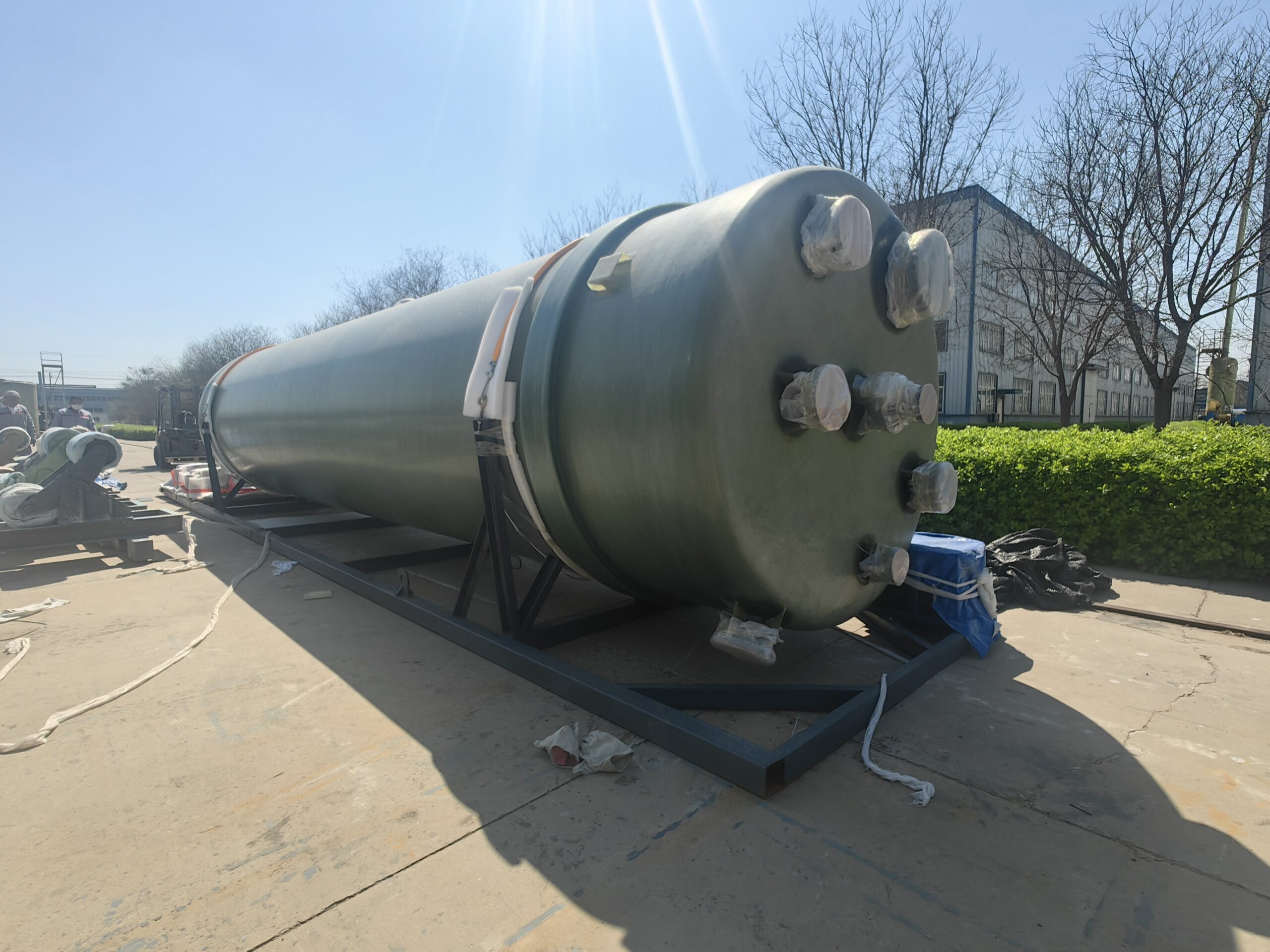
The duty is harder on a vessel than it looks: chloride-bearing acid, an abrasive carbon slurry at every transfer, thousands of fill-and-drain cycles and HCl vapor at the vent. Stainless steel is a poor fit, because chlorides cause pitting and crevice corrosion even at low concentrations. Rubber-lined carbon steel works while the lining is intact, but the vessel is heavy and the lining has to be inspected and repaired for life. A vinyl ester FRP vessel with a corrosion barrier selected for the duty resists dilute HCl through its full wall, with nozzles laminated in as one corrosion-resistant piece and no lining to fail.
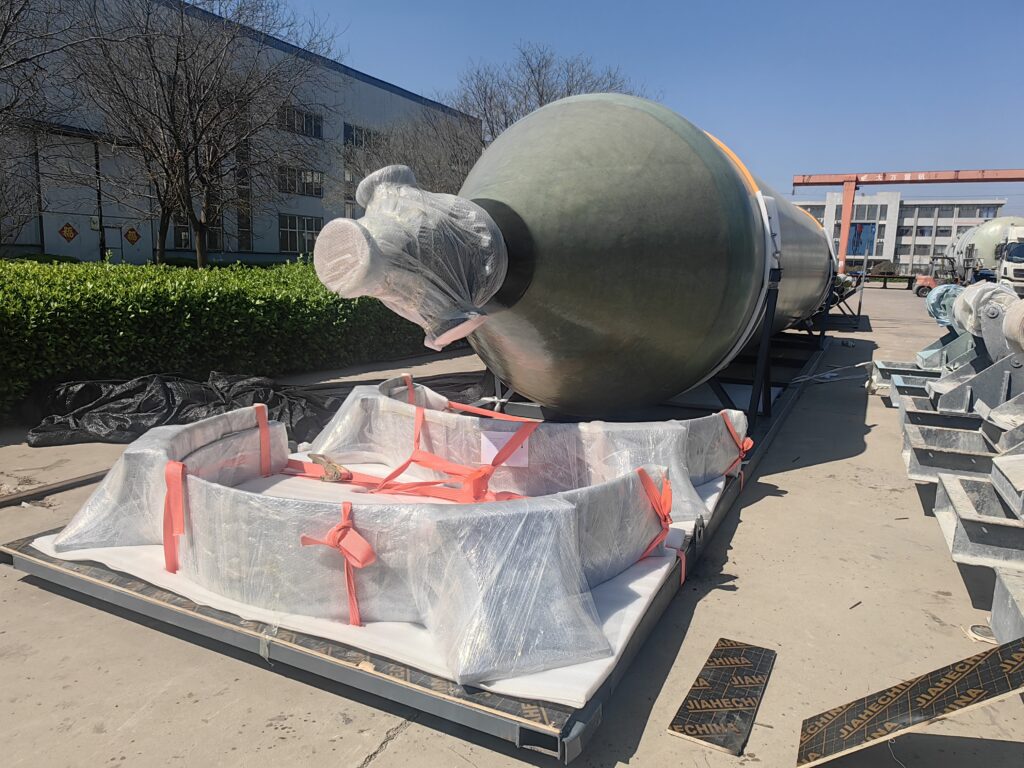
Crimar Industrial has supplied FRP acid wash columns for gold projects since 2016. The vessels are designed to ASME RTP-1, fabricated in Hermosillo, Mexico or in China, and managed as one contract from Tucson, Arizona, with the inspection records and documents an OEM package requires. The most recent delivered vessel handles a carbon batch of about 10 tonnes. Details of the build, from the cone and outlet screens to the transfer connections, are in our acid wash vessel case study for gold ADR and carbon elution plants. A second project shows a custom acid wash vessel delivered with its internal distribution, outlet screening and support frame as one package.
For a plant coming out of care and maintenance, the acid wash vessel deserves an early look. A rubber lining that has sat for years may have cracked, hardened or come away from the shell, and replacement lead time can decide the restart date.
Heap leach ponds: putting the pumps on the water
Pregnant solution, barren solution and event ponds do not hold a steady level. A pump fixed on the bank loses suction when the level drops, and a concrete intake is expensive and hard to build in a lined pond. A pump barge floats with the surface, so the vertical pump keeps constant submergence and the whole unit can be pulled to shore for maintenance.
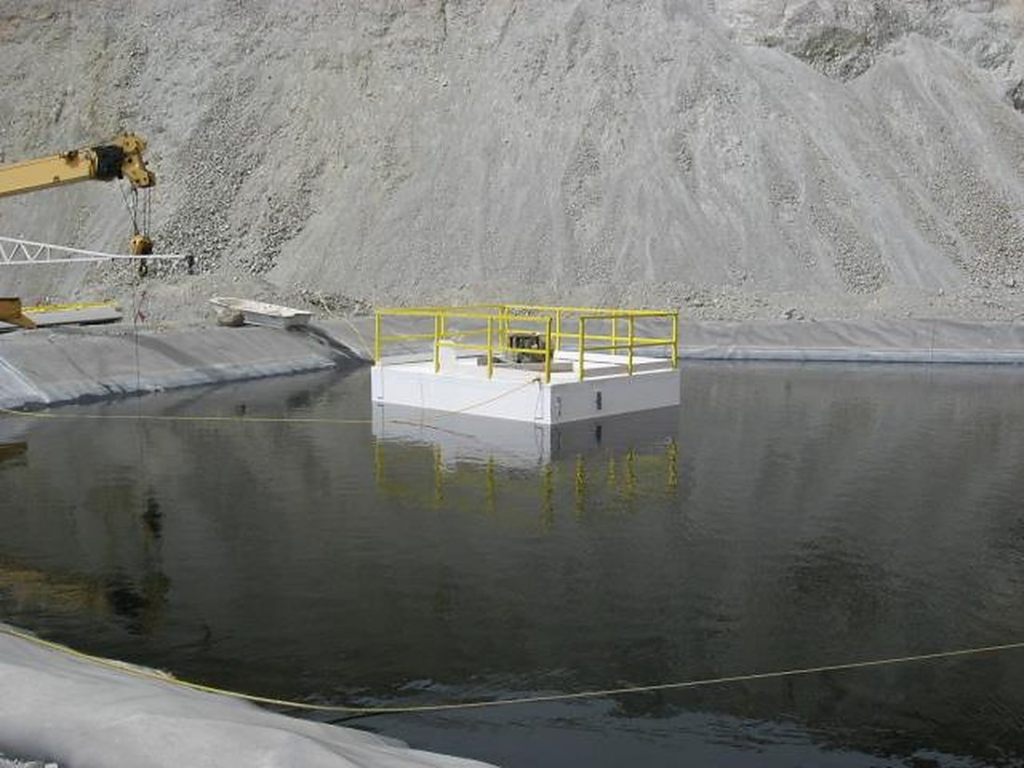
Crimar Industrial has built more than 70 FRP pump barges, plus floating walkways and pipe floats, for mine ponds, pits and reservoirs since 1997. The hulls are foam-filled so they stay afloat if the skin is damaged, they have been built to carry pump and motor weights of 20,000 lb, and they are fiberglass throughout, so nothing metallic can contact an HDPE liner. The resin is selected for the solution chemistry, and the same design approach applies to the solution ponds of a gold heap leach.
Refinery fumes, off-gas and water treatment
Acid fumes from the acid wash vent and the refinery have to be captured and treated, and ductwork carrying wet, acidic air corrodes from the inside where it cannot be seen. FRP ductwork and wet scrubbers are a long-standing answer to that duty. Crimar Industrial has delivered complete FRP scrubbing packages of scrubbers, ductwork and dampers as flanged modules with a full QC dossier, so the pieces fit together on site.
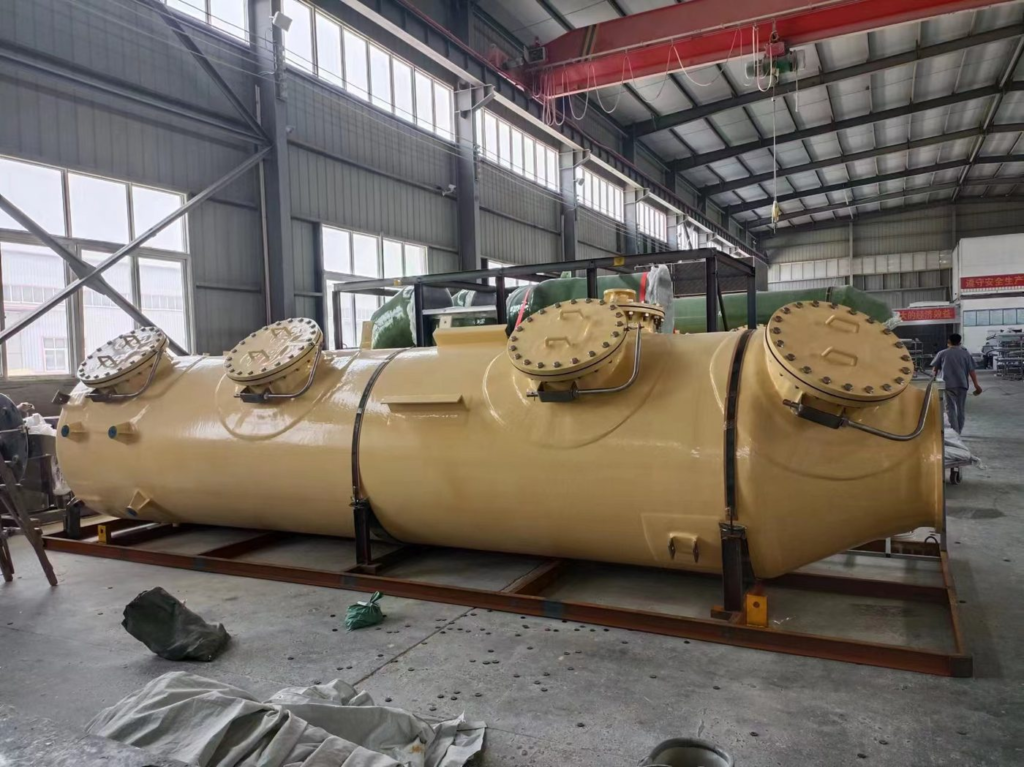
Downstream, mine water and process bleed streams often need neutralization and clarification before reuse or discharge. FRP neutralization tanks, lamella plate packs for high-rate clarifiers and covers for thickeners and launders all suit this wet, corrosive service. See our mining and mineral processing page for the full range.
Restarting an idle gold plant: an FRP checklist
- Inspect existing FRP equipment. Check the corrosion barrier for cracking, blistering and exposed fibers, the exterior for UV damage, and nozzles and supports for movement. Our quality and inspection team can help define what to check.
- Inspect lined steel in acid service. Acid wash vessels, acid tanks and fume ducts with rubber or coating systems are the most likely to need repair or replacement.
- Confirm the duty has not changed. Throughput, carbon batch size, acid concentration and temperature may differ from the original design.
- Review fume handling. Acid wash vents and refinery extraction are easy to overlook until the plant is running.
- Plan pond pumping. Pond levels, liner condition and pump sizes determine whether barges, walkways and pipe floats are needed.
- Check transport and installation limits. Remote sites may call for sectional designs or large-diameter tanks fabricated on site.
What to send for a quote
The fastest quotes start with the medium and its concentration, operating and upset temperature, pressure or vacuum, solids content, the carbon batch size and transfer method for acid wash duty, any drawings or scope sheets, the design standard required and the delivery location. Clear answers at the inquiry stage shorten engineering review and reduce the risk of applying the wrong resin or laminate to the duty.
Frequently asked questions
What material is best for a carbon acid wash vessel?
For dilute hydrochloric acid wash service, vinyl ester FRP is widely used because it resists the acid through its full wall with no lining to maintain. Stainless steel is not recommended because of chloride pitting. Final material selection depends on acid concentration, temperature and the project specification.
Can FRP handle abrasive activated carbon?
Yes, when the laminate is designed for it. Carbon slurry is abrasive at inlets, cones and outlets, and those areas can be built with additional thickness or abrasion-resistant liners. Our article on enhancing abrasion resistance in FRP covers the options.
What standard are FRP acid wash vessels built to?
Crimar Industrial designs its acid wash vessels to ASME RTP-1. Other FRP equipment is engineered and supplied to the applicable project specification and recognized industry standards, as required.
Ready when the plant is
Gold above US$4,000 an ounce gives owners a reason to restart, expand and build. The plants that reach steady production fastest will be the ones whose acid wash, refinery, fume-handling and pond equipment holds up from day one. If you are planning a gold plant restart or expansion, send Crimar Industrial your process conditions, drawings or equipment specifications, and our team will help evaluate the right FRP solution.
Planning a gold plant restart or expansion?
Send your process conditions, drawings or specifications. A Crimar Industrial engineer will review the application and respond.
Sources: Mining Magazine, weekly newsletter, “Good as gold” (16 October 2026), reporting from the FT Metals and Mining Summit; Mackay Gold & Silver Corp., news release on the acquisition of Comstock Inc.’s Nevada mining assets (22 June 2026); World Gold Council, “World Gold Council and OCIM Metals and Mining SA partner to drive collective action for responsible artisanal and small-scale gold mining” (5 August 2026).